Event submissions
Published
This submission belongs to the session H. Food Packaging & Storage Technology of the event The 7th International Electronic Conference on Foods
Published date
23 Oct, 2026
Academic Editor
 Vitor D. Alves
Citation
Moises Ascensión-De la Cruz, Jocelyn García-Zarate, Karla Marlene Palacios-Castro, José Arturo Olguín-Rojas, Paulina Aguirre-Lara, Effect of Schinus molle leaf extract incorporated into starch-based active coating on the preservation of fresh tomatoes, in Proceedings of The 7th International Electronic Conference on Foods, 28 October–30 October 2026, MDPI: Basel, Switzerland
Share
Email
Facebook
Twitter
LinkedIn
Effect of Schinus molle leaf extract incorporated into starch-based active coating on the preservation of fresh tomatoes

Moises Ascensión-De la Cruz 1
Jocelyn García-Zarate 1
Karla Marlene Palacios-Castro 1
José Arturo Olguín-Rojas 1
Paulina Aguirre-Lara 2
1. Ingeniería en Alimentos, Universidad Tecnológica de Tecamachalco, Avenue Universidad Tecnológica 1, Tecamachalco 75483, Mexico.
2. Unidad de Investigación y Desarrollo en Alimentos (UNIDA), Instituto Tecnológico de Veracruz, Tecnológico Nacional de México, Avenue Miguel Ángel de Quevedo 2779, Veracruz 91860, Mexico.
Abstract
The preservation of fresh fruits remains a challenge for the food industry due to quality loss and deterioration during storage. In this context, active coatings have emerged as a sustainable alternative because they act as semipermeable barriers that reduce moisture loss and delay spoilage. Furthermore, the leaves of Schinus molle (“Pirul”) contain phenolic compounds with antimicrobial properties, making them a promising source of bioactive ingredients for food preservation applications.
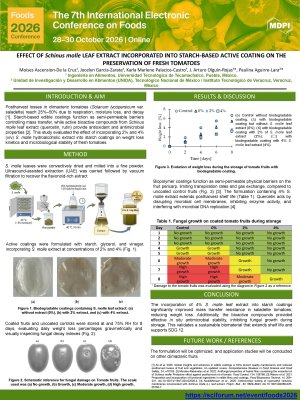
Therefore, the aim of this study was to evaluate the effect of different concentrations of S. molle leaf extract incorporated into starch-based active coating on the preservation and shelf life of fresh tomatoes. Pirul leaves were dehydrated at 40 °C until reaching approximately 5% moisture content, then ground into powder. Bioactive compounds were extracted by ultrasound-assisted extraction at 40 °C for 10 min using a 40% hydroalcoholic solution at a solid-to-liquid ratio of 1:20. Active coatings were formulated with starch (8%), glycerol (4%), and vinegar (4%), incorporating S. molle extract at concentrations of 2% and 4%. Tomatoes with similar size, color, and maturity were coated by immersion and stored at 26 °C for eight days.
After storage, coated tomatoes exhibited lower weight loss than the control treatment. The active coatings containing 4% extract showed the lowest weight loss (1.99 ± 0.4%), followed by the 2% treatment (3.62 ± 0.06%), whereas the control exhibited the highest weight loss (6.67 ± 0.18%). In addition, the 4% extract treatment showed the greatest antimicrobial effect, exhibiting only slight microbial growth according to the simplified fungal index scale for saladette tomatoes, while the control showed severe deterioration. These results demonstrate the potential of S. molle extract as a functional ingredient in starch-based active coatings to extend the shelf life of fresh tomatoes while contributing to Sustainable Development Goal (SDG) 12 on Responsible Consumption and Production.
Keywords
Starch-based biofilms
Pirul leaves extract
food preservation
Poster
Cartel_VF.pdf
Development of Marmalade with an Improved Nutritional Profile Using LMA Pectin and Polydextrose
Reframing Non-Alcoholic Wine Studies: Sensory Characteristics and Bioactive Changes Induced by De-Alcoholization