Event submissions
Published
This submission belongs to the session F. Sensory & Consumer Research of the event The 7th International Electronic Conference on Foods
Published date
23 Oct, 2026
Academic Editor
 José Ángel Pérez-Álvarez
Citation
Matheus Koengkan, Certification Engagement and Consumer Trust in Organic Food Markets: Evidence from Portugal, in Proceedings of The 7th International Electronic Conference on Foods, 28 October–30 October 2026, MDPI: Basel, Switzerland
Share
Email
Facebook
Twitter
LinkedIn
Certification Engagement and Consumer Trust in Organic Food Markets: Evidence from Portugal

Matheus Koengkan 1
1. Strategic Research and Services Unit for Agrarian and Forestry Systems and Plant Health (SAFSV), National Institute for Agrarian and Veterinary Research, I.P. (INIAV, I.P.), Oeiras, 2780-157, Portugal
Abstract
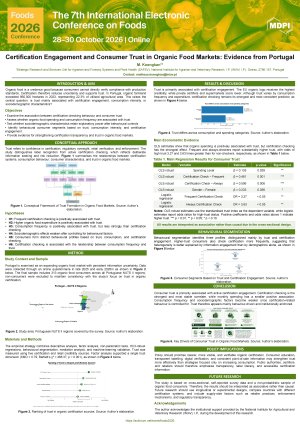
This study examines the associations between consumer trust, certification engagement, and consumption behaviour in the Portuguese organic food market. Using a nationwide survey of organic food consumers in Portugal (N = 313), the analysis adopts a triangulated empirical strategy combining non-parametric tests, econometric models with robust standard errors, behavioural segmentation techniques, and exploratory machine-learning validation. Trust is measured through a composite index derived from exploratory factor analysis of certification- and retail-related credibility indicators. Across all empirical specifications, certification-checking behaviour emerges as the strongest and most consistent factor associated with consumer trust. Consumers who actively verify certification labels and institutional guarantees report significantly higher trust levels in organic food products and retail channels. In contrast, sociodemographic characteristics lose explanatory relevance once behavioural variables are incorporated into the models. Consumption intensity, proxied by monthly expenditure on organic products, exhibits a positive association with trust, although less consistently than certification engagement, while consumption frequency presents weak and unstable associations in multivariate specifications. Behavioural segmentation identifies distinct consumer profiles primarily differentiated by trust perceptions and certification engagement rather than demographic attributes. Furthermore, exploratory mediation analysis does not reveal statistically significant indirect associations between consumption frequency, certification engagement, and trust. Overall, the findings suggest that consumer trust in organic food markets is closely linked to active engagement with certification systems and confidence in institutional verification mechanisms, highlighting the central role of transparency and certification credibility in strengthening sustainable food consumption.
Keywords
Organic food
Consumer trust
Certification behaviour
Credence goods
Consumption intensity
Behavioural segmentation
and Portugal.
Poster
Foods2026_Poster_Certification_Trust_Artigo_1.pdf
Reframing Non-Alcoholic Wine Studies: Sensory Characteristics and Bioactive Changes Induced by De-Alcoholization
Shaping the Future of Food Packaging: Behavioral Insights into Plastic Packaging Decisions in the UK Fast-Moving Consumer Goods (FMCG) Sector