Event submissions
Published
This submission belongs to the session H. Food Packaging & Storage Technology of the event The 7th International Electronic Conference on Foods
Published date
23 Oct, 2026
Academic Editor
 Vitor D. Alves
Citation
Nitish Kumar Singh, Shaping the Future of Food Packaging: Behavioral Insights into Plastic Packaging Decisions in the UK Fast-Moving Consumer Goods (FMCG) Sector, in Proceedings of The 7th International Electronic Conference on Foods, 28 October–30 October 2026, MDPI: Basel, Switzerland
Share
Email
Facebook
Twitter
LinkedIn
Shaping the Future of Food Packaging: Behavioral Insights into Plastic Packaging Decisions in the UK Fast-Moving Consumer Goods (FMCG) Sector

Nitish Kumar Singh 1
1. Business School ( Marketing Deptt.), Liverpool Hope University, Liverpool L16 9JD, UK
Abstract
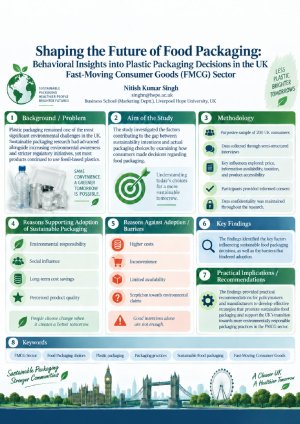
Plastic packaging remained one of the most significant environmental challenges in the UK. Sustainable packaging research had advanced alongside growing environmental awareness and increasingly stringent regulatory initiatives. Despite consumers' willingness to reduce waste and support recycling, the majority of products continued to be packaged using fossil-based plastics. This study investigated the factors contributing to this gap by examining how consumers made decisions regarding food packaging. A purposive sample of 200 UK consumers was recruited for the study. Data were collected through semi-structured interviews to explore the influence of price, information availability, taxation, and product accessibility on packaging choices. Participants provided informed consent prior to participation, and data confidentiality was maintained throughout the research.
The study further explored the reasons consumers gave for adopting or avoiding sustainable food packaging alternatives. The reasons supporting adoption included environmental responsibility, social influence, long-term cost savings, and perceived product quality. In contrast, the reasons against adoption included higher costs, inconvenience, limited availability, and scepticism towards environmental claims. The findings identified the key factors influencing sustainable food packaging decisions, as well as the barriers that hindered their adoption. These findings provided practical recommendations for policymakers and manufacturers to develop effective strategies that promote sustainable food packaging and support the UK's transition towards more environmentally responsible packaging practices in the fast-moving consumer goods sector.
Keywords
FMCG Sector
Food Packaging choices
Plastic packaging
Packaging practices
Sustainable Food packaging
Fast-Moving Consumer Goods
Poster
Nitish Foods Conference Poster 28 Oct 2026.pdf
Certification Engagement and Consumer Trust in Organic Food Markets: Evidence from Portugal
AI-assisted food design: co-creation with young consumers