Event submissions
Published
This submission belongs to the session F. Sensory & Consumer Research of the event The 7th International Electronic Conference on Foods
Published date
23 Oct, 2026
Academic Editor
 José Ángel Pérez-Álvarez
Citation
Jesus Guevara, Damir D. Torrico, Sensory Characterization of Dairy and Plant-Based Yogurts Using Napping® and Multiple Factor Analysis, in Proceedings of The 7th International Electronic Conference on Foods, 28 October–30 October 2026, MDPI: Basel, Switzerland
Share
Email
Facebook
Twitter
LinkedIn
Sensory Characterization of Dairy and Plant-Based Yogurts Using Napping® and Multiple Factor Analysis

Jesus Guevara 1

Damir D. Torrico 1
1. Department of Food Science and Human Nutrition, University of Illinois Urbana-Champaign, Urbana, IL, USA
Abstract
Consumer demand for plant-based yogurt alternatives continues to increase; however, sensory differences between dairy and plant-based products remain a major challenge for the food industry. Rapid sensory profiling methods, such as Napping®, provide an innovative approach for evaluating perceptual similarities and differences among products. Therefore, the objective of this study was to characterize the sensory properties of dairy and plant-based yogurt formulations using Napping® and Multiple Factor Analysis (MFA).
Eleven yogurt formulations were evaluated, including dairy, soy, oat, standardized oat, and matrix-modified oat treatments. Formulations were fermented using two duration times (16 and 24 h). Fifty consumers participated in the Napping® evaluation task in which samples were simultaneously positioned on a two-dimensional space according to perceived similarities and differences. Participants also provided descriptive terms to support their samples’ placement, which were used to interpret the sensory dimensions underlying the product’s spatial configuration. Data were analyzed using Multiple Factor Analysis (MFA).
MFA explained 66.37% of the total variability, with Dimension 1 accounting for 55.10% and Dimension 2 accounting for 11.27%. A clear separation was observed between dairy and plant-based formulations along Dimension 1. Dairy yogurts clustered together and were associated with “creamy” texture and “fermented” dairy characteristics. Oat-based formulations occupied a distinct sensory space, characterized by lower viscosity and greater perception of plant-derived attributes (“fruity” and “plant-like”). Soy samples showed an intermediate position between dairy and oat products. Matrix-modified oat formulations containing hydrocolloids and protein shifted toward the dairy cluster, reflecting improvements in texture-related attributes. These sensory patterns were consistent with physicochemical measurements, particularly viscosity and syneresis.
Napping® effectively differentiated dairy and plant-based yogurt formulations and revealed the sensory effects of matrix modification strategies. The technique provided valuable insights into consumer perception and product positioning, supporting its application in the development of plant-based fermented foods.
Keywords
plant-based yogurt
Napping sensory evaluation
fermentation
multiple factor analysis
oats
Poster
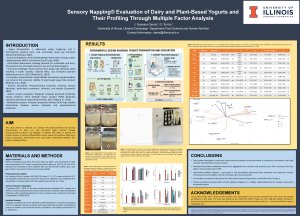
Poster International Electronic Conference 2026_6-30-2026_JG-DT-JG.pdf
Development of Pangasius Mince Sausage Incorporated with Chitosan-Konjac Glucomannan Hydrogel
Packaging evaluation for storage of biscuits with high Jerusalem artichoke content