Event submissions
Published
This submission belongs to the session H. Food Packaging & Storage Technology of the event The 7th International Electronic Conference on Foods
Published date
23 Oct, 2026
Academic Editor
 Vitor D. Alves
Citation
Maria Magdalena Costanzo, Natalia Elizabeth Del Negro, Dario Miguel Arnaldo Mora, Paula Andrea Conforti, Nora Alejandra Comelli, Packaging evaluation for storage of biscuits with high Jerusalem artichoke content, in Proceedings of The 7th International Electronic Conference on Foods, 28 October–30 October 2026, MDPI: Basel, Switzerland
Share
Email
Facebook
Twitter
LinkedIn
Packaging evaluation for storage of biscuits with high Jerusalem artichoke content

Maria Magdalena Costanzo 1
Natalia Elizabeth Del Negro 1
Dario Miguel Arnaldo Mora 1
Paula Andrea Conforti 2,3
Nora Alejandra Comelli 1,4
1. Department of Basic Sciences, Faculty of Engineering and Agricultural Sciences, National University of San Luis, 5730, San Luis, Argentina.
2. Faculty of Agricultural and Forest Sciences, National University of La Plata, 1900, Buenos Aires, Argentina.
3. Center for Research and Development in Food Science and Technology, CONICET, 1900, Buenos Aires, Argentina.
4. Chemical Technology Research Institute, CONICET, 5730, San Luis, Argentina.
Abstract
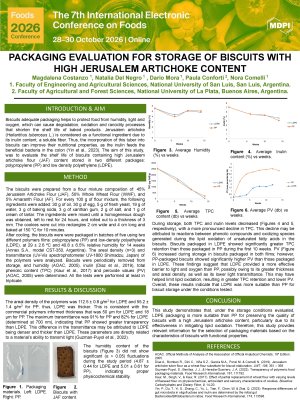
Biscuits adequate packaging helps to protect food from humidity, light and oxygen, which can cause degradation, oxidation and rancidity processes that shorten the shelf life of baked products. Jerusalem artichoke is considered as a functional ingredient due to its inulin content, and its incorporation into biscuits can improve their nutritional properties. In this study, the shelf life of biscuits containing 45% Jerusalem artichoke flour (JAF), 5% amaranth flour and 50% whole wheat flour was analyzed. The biscuits were stored in two different packages: polypropylene (PP) and low-density polyethylene (LDPE), at 29±2.6 ºC and 40.8±6.5% relative humidity for 14 weeks. The surface density and transmittance (UV-Vis spectrophotometer) of the polymers was analyzed. Biscuits were periodically removed from storage, and humidity, inulin, total phenolic content (TPC) and peroxide values (PV) were determined. The surface density of the polymers was 112.5±0.8 g/m2 for LDPE and 55.2±1.4 g/m2 for PP; thus, LDPE was thicker. The maximum transmittance was 91% for PP and 82% for LDPE (700 nm), indicating that PP showed greater transparency than LDPE. The humidity content of the biscuits did not show significant (α=0.05) fluctuations during the study period (4.87±0.44 for LDPE and 5.01±0.61 for PP), indicating proper physicochemical stability. TPC and inulin content decreased during storage, although the decrease was greater for TPC than for inulin. LDPE showed significantly better TPC retention than PP. The PV of the biscuits increased during storage. PP samples (3.31±1.34 mEq peroxide/kg fat) showed significantly higher peroxide values than LDPE (1.21±0.75 mEq peroxide/kg fat). Thus, it can be inferred that LDPE acted as a more efficient barrier to light and oxygen, given its higher surface density and lower transmittance compared to PP. It can be concluded that LDPE packaging can improve the TPC retention and oxidative stability in biscuits containing JAF, under the evaluated storage conditions.
Keywords
Packaging
functional food
Jerusalem artichoke
inulin
peroxide
Poster
Costanzo - Packaging Evaluation for Storage of Biscuits with High Jerusalem Artichoke content.pdf
Sensory Characterization of Dairy and Plant-Based Yogurts Using Napping® and Multiple Factor Analysis
Store to preserve: The impact of different packaging methods on the quality of hazelnuts