Event submissions
Published
This submission belongs to the session H. Food Packaging & Storage Technology of the event The 7th International Electronic Conference on Foods
Published date
23 Oct, 2026
Academic Editor
 Vitor D. Alves
Citation
Ana Cristina Ferrão, Raquel P. F. Guiné, Marco Silva, Paula M.R. Correia, Store to preserve: The impact of different packaging methods on the quality of hazelnuts, in Proceedings of The 7th International Electronic Conference on Foods, 28 October–30 October 2026, MDPI: Basel, Switzerland
Share
Email
Facebook
Twitter
LinkedIn
Store to preserve: The impact of different packaging methods on the quality of hazelnuts

Ana Cristina Ferrão 1

Raquel P. F. Guiné 1
Marco Silva 2
Paula M.R. Correia 1
1. CERNAS-IPV Research Centre, Polytechnic Institute of Viseu, 3504-510 Viseu, Portugal
2. LAQV REQUIMTE, Chemistry Department, NOVA School of Science and Technology NOVA FCT, Caparica, Portugal
Abstract
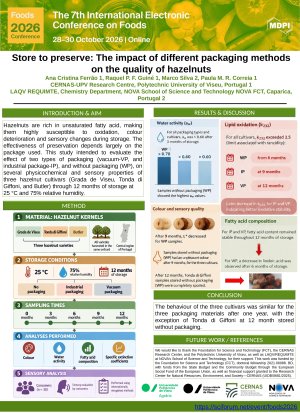
Hazelnuts are rich in unsaturated fatty acid, making them highly susceptible to oxidation, colour deterioration and sensory changes during storage. The effectiveness of preservation depends largely on the package used. This study intended to evaluate the effect of two types of packaging (vacuum-VP, and industrial package-IP), and without packaging (WP), on several physicochemical and sensory properties of three hazelnut cultivars (Grada de Viseu, Tonda di Giffoni, and Butler) through 12 months of storage at 25 °C and 75% relative humidity. Vacuum-sealed packaging was used, and the industrial packaging was carried out at a hazelnut processing company.
The three hazelnut cultivars were collected from the same orchard located in Viseu, Portugal. Physicochemical (colour, water activity, fatty acid composition, and specific extinction coefficients) and sensory analyses by consumers (n = 30) were performed using internationally recognised methods.
For all types of packaging and for the three cultivars, after 3 months of storage, water activity was higher than 0.60, being the samples WP the ones with higher values (aw>0.70). For the three cultivars, the extinction coefficients at 232 nm (k232) exceed 2.5 (limit associated with rancidity) starting at 6 months for the samples WP, being this observed at 9 and 12 months for IP and VP, respectively. For IP and VP, the fatty acid content remained stable throughout the 12 months of storage, but for the samples WP, at 6 months of storage, it was observed a decrease in linoleic acid. After 9 months, L* decreased for storage WP and the samples stored WP had an unpleasant odour, being this observed for the three cultivars. Furthermore, after 12 months of storage, Tonda di Giffoni samples stored WP were completely spoiled.
Vacuum packaging showed better results, minimizing lipid oxidation, preserving sensory quality, and extending shelf life. The behaviour of the three cultivars was similar for the three packaging materials after one year, with the exception of Tonda di Giffoni at 12 month stored without packaging.
Keywords
hazelnuts
packaging
storage
cultivars
sensory analysis
physicochemical properties
Poster
Foods poster 2026-CristinaFerrao.pdf
Packaging evaluation for storage of biscuits with high Jerusalem artichoke content
Mapping Alternative Food Product Perceptions: The Interplay of PROP Taster Status and Food Neophobia