Event submissions
Published
This submission belongs to the session F. Sensory & Consumer Research of the event The 7th International Electronic Conference on Foods
Published date
23 Oct, 2026
Academic Editor
 José Ángel Pérez-Álvarez
Citation
Raquel P. F. Guiné, Filipa P. Costa, Sofia G. Florença, Visualization of television cooking shows and culinary programs: Insights from a sample of Portuguese citizens, in Proceedings of The 7th International Electronic Conference on Foods, 28 October–30 October 2026, MDPI: Basel, Switzerland
Share
Email
Facebook
Twitter
LinkedIn
Visualization of television cooking shows and culinary programs: Insights from a sample of Portuguese citizens

Raquel P. F. Guiné 1

Filipa P. Costa 1

Sofia G. Florença 1
1. CERNAS-IPV Research Centre, Polytechnic University of Viseu, Viseu, Portugal
Abstract
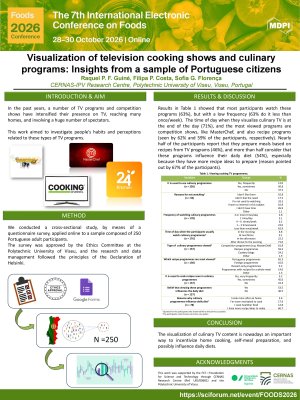
Introduction: In the past years, a number of TV programs and competition shows have intensified their presence on TV, reaching many homes, and involving a huge number of spectators. This work aimed to investigate people’s habits and perceptions related to these types of TV programs.
Methods: We conducted a cross-sectional study, by means of a questionnaire survey, applied online to a sample composed of 250 Portuguese adult participants. The survey was approved by the Ethics Committee at the Polytechnic University of Viseu, and the research and data management followed the principles of the Declaration of Helsinki. Statistical treatment of data was made using SPSS software.
Results and Discussion: Results showed that most participants watch these programs (63%), but with a low frequency (63% do it less than once/week). The time of day when they visualize culinary TV is at the end of the day (71%), and the most viewed programmes are competition shows, like MasterChef, and also recipe programs (seen by 62% and 59% of the participants, respectively). Nearly half of the participants report that they prepare meals based on recipes from TV programs (46%), and more than half consider that these programs influence their daily diet (54%), especially because they have more recipe ideas to prepare (reason pointed out by 67% of the participants).
Conclusions: The visualization of culinary TV content is nowadays an important way to incentivise home cooking, self-meal preparation, and possibly influence daily diets.
Keywords
Television programs
Culinary TV
Meal preparation
Daily diet
Poster
Poster_TV Cooking_GuineRPF.pdf
Effects of storage temperature and packaging type on the postharvest quality of finger lime (Citrus australasica)
Effect of plant sterols and dietary fiber among Filipino adults with moderately raised serum cholesterol levels