Event submissions
Published
This submission belongs to the session B. Nutritional & Functional Foods of the event The 7th International Electronic Conference on Foods
Published date
23 Oct, 2026
Academic Editor
 Juana Fernández López
Citation
Babylyn D. Cayabyab, Cecile Leah T. Bayaga, Effect of plant sterols and dietary fiber among Filipino adults with moderately raised serum cholesterol levels, in Proceedings of The 7th International Electronic Conference on Foods, 28 October–30 October 2026, MDPI: Basel, Switzerland
Share
Email
Facebook
Twitter
LinkedIn
Effect of plant sterols and dietary fiber among Filipino adults with moderately raised serum cholesterol levels

Babylyn D. Cayabyab 1
Cecile Leah T. Bayaga 2
1. Dairy Health and Nutrition Solutions, Nestlé Philippines, Inc., Makati City, 1229, Philippines
2. Department of Food Science and Nutrition, College of Home Economics, University of the Philippines Diliman, Quezon City, 1101, Philippines
Abstract
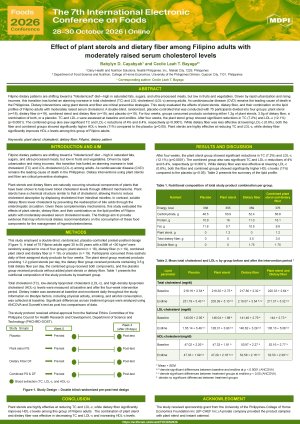
Filipino dietary patterns are shifting toward a "Westernized" diet—high in saturated fats, sugars, and ultra-processed meats, but low in fruits and vegetables. Driven by rapid urbanization and rising incomes, this transition has fueled an alarming increase in total cholesterol (TC) and LDL-cholesterol (LDL-c) among adults. As cardiovascular disease (CVD) remains the leading cause of death in the Philippines. Dietary interventions using plant sterols and fiber are critical preventive strategies. This study evaluated the effects of plant sterols, dietary fiber, and their combination on the lipid profiles of Filipino adults with moderately raised serum cholesterol. A double-blind, randomized, placebo-controlled trial was conducted with 75 participants divided into four groups: plant sterol (n=18), dietary fiber (n=19), combined sterol and dietary fiber (n=19), and placebo (n=19). For four weeks, groups consumed products containing either 1.2g of plant sterols, 3.5g of dietary fiber, a combination of both, or a placebo. TC and LDL-c were assessed at baseline and endline. After four weeks, the plant sterol group showed significant reductions in TC (7.2%) and LDL-c (12.1%) (p<0.0001$). The combined group also saw significant TC and LDL-c reductions of 4% and 6.4%, respectively (p<0.0001). While dietary fiber was less effective at lowering LDL-c (0.6%), both the fiber and combined groups showed significantly higher HDL-c levels (11%) compared to the placebo (p<0.05). Plant sterols are highly effective at reducing TC and LDL-c, while dietary fiber significantly improves HDL-c levels among this group of Filipino adults.
Keywords
plant sterol
cholesterol
dietary fiber
Filipino
Poster
sciforum-179600.pdf
Visualization of television cooking shows and culinary programs: Insights from a sample of Portuguese citizens
Exploring consumers’ perception of craft beer from social agriculture tracked with blockchain technology