Event submissions
Published
This submission belongs to the session F. Sensory & Consumer Research of the event The 7th International Electronic Conference on Foods
Published date
23 Oct, 2026
Academic Editor
 José Ángel Pérez-Álvarez
Citation
Nazarena Cela, Michele Filippo Fontefrancesco, Maya Celestina Carrara, Chiara Nervo, Luisa Torri, Exploring consumers’ perception of craft beer from social agriculture tracked with blockchain technology, in Proceedings of The 7th International Electronic Conference on Foods, 28 October–30 October 2026, MDPI: Basel, Switzerland
Share
Email
Facebook
Twitter
LinkedIn
Exploring consumers’ perception of craft beer from social agriculture tracked with blockchain technology

Nazarena Cela 1

Michele Filippo Fontefrancesco 2

Maya Celestina Carrara 1
Chiara Nervo 1

Luisa Torri 1
1. University of Gastronomic Sciences, 12042, Bra, CN, Italy
2. Department of Sociology, Università Cattolica del Sacro Cuore, Milan, 20123, Italy
Abstract
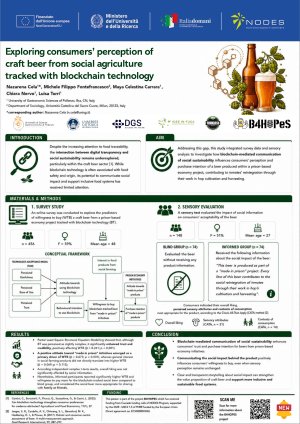
Despite growing interest in food traceability, the intersection between digital transparency and social sustainability remains underexplored, particularly within the craft beer sector. This study addressed this gap by investigating how blockchain-mediated communication about social sustainability influences consumers’ perceptions and willingness to buy a beer produced within a prison-based economy project that supports inmates’ reintegration through their work in hop cultivation and harvesting. Firstly, an online survey (n = 456) explored the willingness to buy (WTB) a social beer tracked with blockchain technology (BT). Partial Least Square Structural Equation Modelling showed that, although BT was perceived as slightly complex, it significantly enhanced trust, positively affecting WTB. A significant positive attitude toward “made in prison” initiatives emerged as the primary driver of WTB, whereas general interest in social farming did not directly translate into higher WTB. Secondly, a sensory test (n = 148) evaluated the impact of social information on beer acceptability. Participants were divided into a Blind and an Informed group (only the latter receiving details on social impact). Independent-samples t-tests showed that social information did not significantly affect liking scores or WTB, but Informed participants considered the social beer more appropriate for sharing with family or friends, thus appreciating it not only for its sensory quality but also for its social value. By linking digital traceability with social impact, these findings demonstrated how the brewing industry can contribute to SDG 8 (Decent Work and Economic Growth) and SDG 12 (Responsible Consumption and Production), supporting socially responsible brewing initiatives.
Keywords
Consumer preferences
Digital technologies
Partial Least Square Structural Equation Modelling
Social sustainability
Traceability
Trust
Poster
poster_Foods2026_Cela.pdf
Effect of plant sterols and dietary fiber among Filipino adults with moderately raised serum cholesterol levels
Valorization of Mediterranean Aromatic Plants for the Production of Functional Films for Food Applications