Event submissions
Published
This submission belongs to the session H. Food Packaging & Storage Technology of the event The 7th International Electronic Conference on Foods
Published date
23 Oct, 2026
Academic Editor
 Vitor D. Alves
Citation
Pedro Melgarejo Martinez, Antonio Jose Pérez-López, Jose Ramon Acosta Motos, Effect of Packaging Material on the Color Stability of Refrigerated Mandarin Juice During Storage, in Proceedings of The 7th International Electronic Conference on Foods, 28 October–30 October 2026, MDPI: Basel, Switzerland
Share
Email
Facebook
Twitter
LinkedIn
Effect of Packaging Material on the Color Stability of Refrigerated Mandarin Juice During Storage

Pedro Melgarejo Martinez 1

Antonio Jose Pérez-López 2,3

Jose Ramon Acosta Motos 2,3
1. Eversia, Pol. Ind. El Saladar II, Calle Madrid s/n, Lorquí, Murcia, 30564, Spain
2. Plant Biotechnology for Food and Agriculture Group (BioVegA2), Universidad Católica San Antonio de Murcia, Avenida de los Jerónimos 135, Murcia, 30107 Guadalupe, Spain
3. Plant Biotechnology, Agriculture and Climate Resilience Group, UCAM-CEBAS-CSIC, Associated Unit to CSIC by CEBAS-CSIC, Murcia, 30100, Spain
Abstract
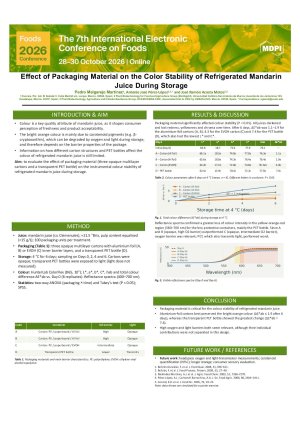
Introduction: Color is a key quality attribute of mandarin juice, influencing consumer perception of freshness and product acceptability. The bright orange color is mainly associated with carotenoid pigments, which can be affected by storage conditions and packaging barrier properties. This study evaluated the effect of different packaging materials on the instrumental color stability of refrigerated mandarin juice during storage.
Methods: A batch of 100 packaging units per treatment was used. Mandarin juice was packed in three non-transparent multilayer cartons with contrasting inner barrier layers (aluminum foil or ethylene vinyl alcohol copolymer, high to intermediate oxygen barrier) and in a transparent, light-permeable PET bottle (lower barrier), and stored at 4°C for 6 days, consistent with the shelf life reported for non-thermally treated refrigerated citrus juice. Instrumental color (L*, a*, b*, C*, hab) was measured periodically during storage (six replicates), and visible reflectance spectra (400-700 nm) assessed yellow-orange-red region changes. Data were analyzed by ANOVA and Tukey's test (P<0.05).
Results: Packaging material significantly affected (P<0.05) the chromatic stability of refrigerated mandarin juice. All samples showed a progressive decrease in L*, a*, b* and C* values, indicating darkening, loss of reddish-orange intensity, and reduced vividness. High-barrier cartons showed significantly better preservation of the initial orange color than lower-barrier materials. Transparent, light-exposed PET showed the greatest deterioration, with the lowest L* and C* values and a higher total color difference (ΔE*) than the best-performing carton by the end of storage. Reflectance spectra confirmed a greater loss of color intensity in the orange-red region for juices packed in less protective materials.
Conclusions: Packaging material selection is critical for maintaining color quality in refrigerated mandarin juice. High oxygen- and light-barrier packaging (e.g., aluminum-foil-lined cartons) best preserved the bright orange color and reduced chromatic degradation during storage.
Keywords
mandarin
color
juice
Poster
Effect of Packaging Material on the Color Stability of Refrigerated Mandarin Juice During Storage.pdf
BEFORE TASTE: THE ROLE OF VISION IN FLAVOUR PERCEPTION
Development of Low-Fat Enrobed Fish Cutlets Using Konjac Glucomannan: Effect on Technological and Quality Attributes