Event submissions
Published
This submission belongs to the session B. Nutritional & Functional Foods of the event The 7th International Electronic Conference on Foods
Published date
23 Oct, 2026
Academic Editor
 Manuel Viuda-Martos
Citation
Chantelle Human, Marique Aucamp, Dalene De Beer, Stability and protein-phenolic interactions of ready-to-use protein-packed functional honeybush tea powder formulations., in Proceedings of The 7th International Electronic Conference on Foods, 28 October–30 October 2026, MDPI: Basel, Switzerland
Share
Email
Facebook
Twitter
LinkedIn
Stability and protein-phenolic interactions of ready-to-use protein-packed functional honeybush tea powder formulations.

Chantelle Human 1
Marique Aucamp 2
Dalene De Beer 1
1. Post-Harvest and Agro-Processing Technologies, Agricultural Research Council (Infruitec-Nietvoorbij), Stellenbosch, 7599, South Africa
2. School of Pharmacy, University of the Western Cape, Bellville, 7535, South Africa
Abstract
Background
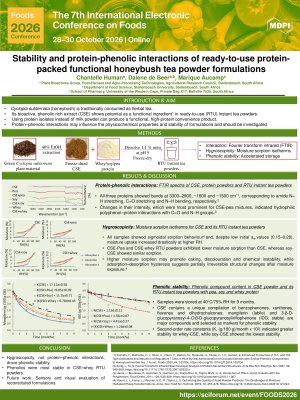
Cyclopia subternata (honeybush) is traditionally consumed as herbal tea. Its bioactive phenolic-rich extracts (CSE) show potential as functional ingredients in ready-to-use (RTU) instant tea powders. The use of protein isolates instead of milk powder can be used to produce a functional high-protein convenience product. However, protein–phenolic interactions may influence physicochemical properties, stability, and bioactivity of phenolic compounds.
Objectives
This study formulated CSE-based RTU powders with whey, pea, and soy protein isolates (1:1 CSE: protein) to evaluate (i) physicochemical characteristics and (ii) phenolic stability (40°C/7% and 75% RH for 9 months).
Results and Discussion
Solid-state characterization (FTIR, DSC, and XRPD) showed amorphous systems and protein conformational changes linked to hydrogen bonding and hydrophobic interactions with phenolics.
Moisture sorption analysis indicated reduced hygroscopicity in soy- and pea-based formulations compared to CSE alone. Water activity values (<0.61) suggested microbiological stability, though moisture contents above monolayer values (calculated using the GAB model) indicated increased molecular mobility and potential physical and chemical degradation.
Second-order reaction rates indicated improved stability of CSE phenolics (quantified with HPLC-DAD) in whey protein formulations compared with CSE alone, while soy protein reduced stability. Of the 10 quantified phenolic compounds, whey protein particularly stabilized (>2.5-fold) hesperidin, scolymoside, mangiferin, and isomangiferin, indicating compound-specific interactions.
Conclusions
Protein–phenolic interactions were confirmed and, together with changes in hygroscopicity, influenced phenolic stability, which could affect bioactivity. Reduced degradation could be explained by steric and chemical shielding. Whey protein isolate demonstrated superior stabilization of CSE phenolics, supporting its use in RTU formulations. Complementary future work should include sensory and visual evaluation and assessment of rehydrated formulations with added food-grade ingredients.
Keywords
Protein-phenolic interactions
bioactive phenolic compounds
stability
functional ready-to-use powder
high protein content
honeybush.
Poster
CHuman POSTER_183455.pdf
Development of Low-Fat Enrobed Fish Cutlets Using Konjac Glucomannan: Effect on Technological and Quality Attributes
Environmental Concern Challenges the Health Halo: Rethinking the Communication Strategy for Organic Foods in Emerging European Markets