Event submissions
Published
This submission belongs to the session F. Sensory & Consumer Research of the event The 7th International Electronic Conference on Foods
Published date
23 Oct, 2026
Academic Editor
 José Ángel Pérez-Álvarez
Citation
Nicolle Stefani Juncos, Gisela Kay Guerberoff, Maria Paz Corradi, Rubén Horacio Olmedo, Sensory effects of using the Cymbopogon genus as a flavoring agent in cream cheese: focus group and descriptive analysis, in Proceedings of The 7th International Electronic Conference on Foods, 28 October–30 October 2026, MDPI: Basel, Switzerland
Share
Email
Facebook
Twitter
LinkedIn
Sensory effects of using the Cymbopogon genus as a flavoring agent in cream cheese: focus group and descriptive analysis

Nicolle Stefani Juncos 1
Gisela Kay Guerberoff 2
Maria Paz Corradi 1
Rubén Horacio Olmedo 3
1. Universidad Nacional de Córdoba. Facultad de Ciencias Agropecuarias. Laboratorio de Tecnología de Alimentos (LabTA)CONICET. Instituto Multidisciplinario de Biología Vegetal (IMBIV), Córdoba, Argentina
2. Universidad Nacional de Córdoba. Facultad de Ciencias Agropecuarias. Laboratorio de Tecnología de Alimentos (LabTA), Córdoba, Argentina
3. Universidad Nacional de Córdoba. Facultad de Ciencias Agropecuarias. Laboratorio de Tecnología de Alimentos (LabTA). CONICET. Instituto de Ciencia y Tecnología de los Alimentos Córdoba (ICYTAC), Córdoba, Argentina
Abstract
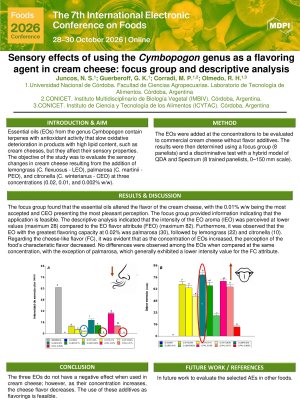
Essential oils (EOs) from the genus Cymbopogon contain terpenes with antioxidant activity that slow oxidative deterioration in products with high lipid content, such as cream cheeses, but they affect their sensory properties. The objective of the study was to evaluate the sensory changes in cream cheese resulting from the addition of lemongrass (C. flexuosus - LEO), palmarosa (C. martinii - PEO), and citronella (C. winterianus - CEO) at three concentrations (0.02, 0.01, and 0.002% w/w). The EOs were added at the concentrations to be evaluated to commercial cream cheese without flavor additives. The results were then determined using a focus group (8 panelists) and a discriminative test with a hybrid model of QDA and Spectrum (8 trained panelists, 0–150 mm scale). The focus group found that the essential oils altered the flavor of the cream cheese, with the 0.01% w/w being the most accepted and CEO presenting the most pleasant perception. The focus group provided information indicating that the application is feasible. The descriptive analysis indicated that the intensity of the EO aroma (IEO) was perceived at lower values (maximum 28) compared to the EO flavor attribute (FEO) (maximum 82). Furthermore, it was observed that the EO with the greatest flavoring capacity at 0.02% was palmarosa (30), followed by lemongrass (22) and citronella (10). Regarding the cheese-like flavor (FC), it was evident that as the concentration of EOs increased, the perception of the food’s characteristic flavor decreased. No differences were observed among the EOs when compared at the same concentration, with the exception of palmarosa, which generally exhibited a lower intensity value for the FC attribute. The three EOs do not have a negative effect when used in cream cheese; however, as their concentration increases, the cheese flavor decreases. The use of these additives as flavorings is feasible.
Keywords
essential oils
natural additives
cheese flavouring
sensory analysis
lemongrass
Poster
Foods 2026 - Corradi 1..pdf
Sensory impact of three essential oils from the genus Cymbopogon as natural flavorings for fermented yogurt
Visual hierarchy, attention and choice: an eye-tracking study of PGI extra virgin olive oil packaging