Event submissions
Published
This submission belongs to the session F. Sensory & Consumer Research of the event The 7th International Electronic Conference on Foods
Published date
23 Oct, 2026
Academic Editor
 José Ángel Pérez-Álvarez
Citation
Marco Fazio, Francesco Maiuolo, Visual hierarchy, attention and choice: an eye-tracking study of PGI extra virgin olive oil packaging, in Proceedings of The 7th International Electronic Conference on Foods, 28 October–30 October 2026, MDPI: Basel, Switzerland
Share
Email
Facebook
Twitter
LinkedIn
Visual hierarchy, attention and choice: an eye-tracking study of PGI extra virgin olive oil packaging

Marco Fazio 1

Francesco Maiuolo 2
1. Department of Business and Legal Sciences, Università della Calabria (University of Calabria), Rende (CS), 87036, Italy
2. Independent Researcher, Cosenza, Italy
Abstract
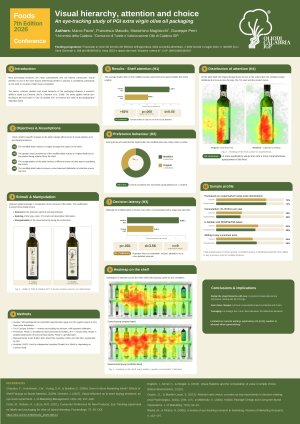
Packaging is a key driver of in-store purchase decisions, yet many purchases occur under conditions of low attention and high visual competition. This study tests whether redesigning the front label of an extra virgin olive oil carrying a Protected Geographical Indication (PGI) affects consumers' visual attention and choice. Using a between-subjects design, 100 habitual olive-oil buyers (50 control, 50 experimental) completed a remote, webcam-based eye-tracking session comprising a simulated shelf task and an isolated-bottle viewing task. The experimental label removed a dominant vertical wordmark, enlarged the logo, denomination and PGI mark, and rebalanced the visual hierarchy. At the shelf, the redesigned label nearly doubled mean fixation time (1.14 versus 0.59 seconds; Welch p = .008, d = 0.55) and spread attention more evenly across front-of-pack elements rather than concentrating it on a single feature. Choice and pre-click latency pointed in the same direction: the redesigned label was selected about twice as often and prompted longer deliberation, although these effects rest on a small subsample and should be considered only preliminary. Findings indicate that even modest changes to visual hierarchy can measurably enhance attention to PGI cues, supporting packaging as a strategic silent salesman. These results align with attention-based models of choice. Implications for label design and geographical-indication branding are discussed.
Keywords
eye tracking
visual attention
packaging design
consumer choice
Protected Geographical Indication (PGI)
extra virgin olive oil
Poster
Sciforum-200155 Poster Marco Fazio.pdf
Sensory effects of using the Cymbopogon genus as a flavoring agent in cream cheese: focus group and descriptive analysis
Nutritional Composition of Common Beans for Succulent Stage Harvest in the Mid-Atlantic USA