Event submissions
Published
This submission belongs to the session F. Sensory & Consumer Research of the event The 7th International Electronic Conference on Foods
Published date
23 Oct, 2026
Academic Editor
 José Ángel Pérez-Álvarez
Citation
Lei Marie Alcantara, Leila Reigne Quesada, Rejean Shanley Embestro, Elizabeth Giro, Erwin Limbo Descallar, Characterization of Banana Blossom (Musa acuminata Colla) and Taro (Colocasia esculenta) Flours and Their Application in Soft Cookies, in Proceedings of The 7th International Electronic Conference on Foods, 28 October–30 October 2026, MDPI: Basel, Switzerland
Share
Email
Facebook
Twitter
LinkedIn
Characterization of Banana Blossom (Musa acuminata Colla) and Taro (Colocasia esculenta) Flours and Their Application in Soft Cookies

Lei Marie Alcantara 1
Leila Reigne Quesada 1
Rejean Shanley Embestro 1
Elizabeth Giro 1
Erwin Limbo Descallar 1
1. Department of Food Technology, Polytechnic University of the Philippines, Manila, Philippines
Abstract
This study evaluated banana blossom flour (BBF) and taro flour (TF) as partial substitutes for all-purpose flour (APF) in soft cookies. Banana blossoms and taro tubers were dried at 70 °C for 4 and 3 h, respectively, milled, and sieved through a 60-mesh screen. Nine composite flour formulations were developed using D-optimal mixture design, with BBF, TF, and APF ranging from 3–15%, 10–30%, and 55–87%, respectively. The physicochemical, proximate, pasting, microbiological, and sensory properties of the flours and cookie formulations were determined. BBF had higher crude protein (28.16 ± 1.00%), crude fiber (22.43 ± 0.90%), ash (12.43 ± 0.07%), total phenolic content (27.86 ± 1.66 mg GAE/100 g), and DPPH radical scavenging activity (36.80 ± 0.23%) than TF, whereas TF had higher nitrogen-free extract (78.14%). Pasting analysis indicated distinct technological functions relevant to cookie production. BBF showed high peak viscosity (7279 cP), suggesting strong water-binding and thickening capacity, but its low hot-paste stability may constrain performance during heating and shearing. Conversely, TF had lower breakdown viscosity (261 cP), higher final viscosity (1956 cP), and better thermal stability, indicating its possible contribution to dough consistency and baked texture. Sensory evaluation was conducted in two stages. In the first stage, 45 semi-trained panelists evaluated the nine formulations using Quantitative Descriptive Analysis and a 9-point hedonic scale, showing significant formulation effects on appearance, color, aroma, texture, taste, and overall acceptability (p < 0.05). BT07 (3:20:77 BBF:TF:APF) ranked highest, followed by BT01 (3:10:87 BBF:TF:APF). In the second-stage consumer acceptability test, BT01 obtained the highest overall acceptability score (7.49). Results indicate that BBF and TF can be incorporated in soft cookies, but acceptable quality was best maintained at low substitution levels.
Keywords
Banana Blossom Flour
Taro
Sensory Evaluation
Soft Cookies
Poster
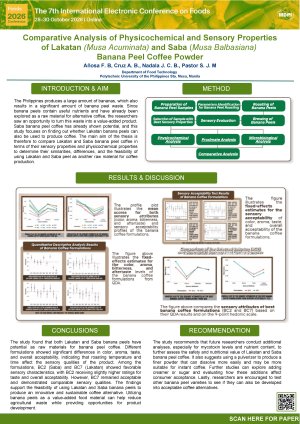
Banana Coffee Poster.pdf
Nutritional Composition of Common Beans for Succulent Stage Harvest in the Mid-Atlantic USA
Consumer Acceptance of Upcycled Foods: Attitudes, Neophobia, and Nutrition Involvement of Filipino Consumers