Event submissions
Published
This submission belongs to the session H. Food Packaging & Storage Technology of the event The 7th International Electronic Conference on Foods
Published date
23 Oct, 2026
Academic Editor
 Vitor D. Alves
Citation
Maria Apostolia Pissia, Anthia Matsakidou, Nikolaos Nenadis, Adamantini Paraskevopoulou, Evaluating the storage stability of snail meat powders from Cornu aspersum, in Proceedings of The 7th International Electronic Conference on Foods, 28 October–30 October 2026, MDPI: Basel, Switzerland
Share
Email
Facebook
Twitter
LinkedIn
Evaluating the storage stability of snail meat powders from Cornu aspersum

Maria Apostolia Pissia 1

Anthia Matsakidou 1

Nikolaos Nenadis 1

Adamantini Paraskevopoulou 1
1. School of Chemistry, Aristotle University of Thessaloniki, Thessaloniki, Greece
Abstract
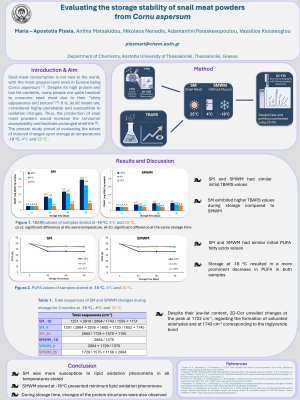
Snail meat is a cherished delicacy in both African and European cuisines, known for its unique flavor, high protein, and low fat content. The utilization of snail meat powder broadens the field of food applications potentially boosting the acceptability and widening the market by increasing product’s shelf-life. However, traces of lipids and chemical composition may induce chemical destabilization during storage and affect its final quality. Therefore, this study aims at assessing the influence of storage temperatures on the chemical stability of freeze-dried meat of Cornu aspersum, a species frequently consumed in the Mediterranean region.
Fourier transform infrared (FTIR) spectroscopy, combined with generalized-2D correlation (g-2D-COR) analysis, determination of TBARS values and fatty acid profile were employed to investigate time-induced changes in freeze-dried snail meat (SM) and freeze-dried snail meat without mucus (SMWM) during a 3-month storage period at -18, 4, and 25 °C. Even though both preparations had low fat contents, vibrations associated with lipid oxidation were successfully unveiled using g-2D-COR. The region around 1711–1739 cm⁻¹ (carbonyl ester bonds/peroxidation products), initially absent in standard FTIR spectra, was revealed to change dynamically across all samples. Storage triggered an increase in TBARS values and a decrease in polyunsaturated fatty acids. The observed degradations were more pronounced at 4 °C and -18 °C than at 25 °C. Throughout the study, SM exhibited drastically higher susceptibility to oxidation, whereas SMWM demonstrated exceptional oxidative stability across all conditions, indicating the need of prior mucus removal. While SM experiences significant polyunsaturated fatty acid degradation and elevated TBARS values, particularly at 4 °C and -18 °C, SMWM remains highly resistant to lipid oxidation under all conditions. Furthermore, the integration of FTIR spectroscopy with g-2D-COR analysis successfully unmasked subtle, time-induced lipid transformations, proving to be a highly sensitive methodology for quality control in high-added-value dehydrated food matrices.
Keywords
Snail meat
Storage
FTIR
2D correlation
Lipid oxidation
Poster
PISSIA.pdf
Multicriteria Quality Indices as a Tool for Estimating Consumer Desirability of Gluten-Free Bread Enriched with Chestnut Flour
CNN-based binary pollen classification for monofloral honey authentication with conventional light microscopy