Event submissions
Published
This submission belongs to the session A. AI, Technology & Engineering in Food of the event The 7th International Electronic Conference on Foods
Published date
23 Oct, 2026
Academic Editor
 Nazimah Hamid
Citation
Lorena Sofia Pepa, Cristina Isabel dos Santos Ferreira, María del Pilar Buera, Phenylalanine-Based Supramolecular Gels for Structuring Apple Juice Matrices, in Proceedings of The 7th International Electronic Conference on Foods, 28 October–30 October 2026, MDPI: Basel, Switzerland
Share
Email
Facebook
Twitter
LinkedIn
Phenylalanine-Based Supramolecular Gels for Structuring Apple Juice Matrices

Lorena Sofia Pepa 1
Cristina Isabel dos Santos Ferreira 2
María del Pilar Buera 1,2,3
1. Universidad de Buenos Aires, Facultad de Ciencias Exactas y Naturales, Departamento de Industrias., Buenos Aires, Argentina
2. Universidad de Buenos Aires, Facultad de Ciencias Exactas y Naturales, Departamento de Química Orgánica., Buenos Aires, Argentina
3. CONICET-Universidad de Buenos Aires. Instituto de Tecnología de Alimentos y Procesos Químicos (ITAPROQ)., Buenos Aires, Argentina
Abstract
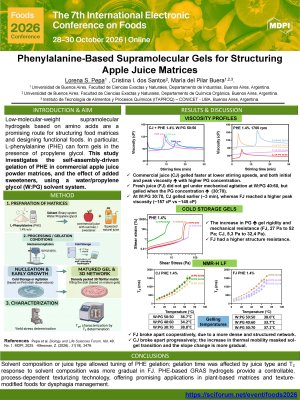
The development of low-molecular-weight supramolecular hydrogels based on amino acids emerges as a promising approach for food matrix structuring and functional food design. Particularly noteworthy is the ability of L-phenylalanine (PHE) to form gels in the presence of propylene glycol. Building upon previous findings where a binary water/propylene glycol system (50:50 v/v) containing 1.0% w/v PHE achieved gelation either through mechanical agitation or cold storage, this study investigates the gelation behavior and process parameters of PHE self-assembly in complex commercial or natural apple juice matrices. The incorporation of juice altered gelation kinetics, requiring adjustments in PHE concentration (1.0%–1.4% w/v), mechanical energy input (1000–2000 rpm agitation), or storage conditions. Both sucrose or sweetener-added commercial juice (1.0% or 1.2% w/v PHE) maintained a viscosity value of 72 mPa.s during 30 min of agitation at 1000 rpm, showing no gelation. However, sweetener-added commercial juice at 1.2% PHE formed a self-standing hydrogel after 1 week at 4 °C. At 1.4% w/v PHE, this system exhibited average viscosity peaks by increasing stirring speed; 126.6 mPa.s at 9.25 min (1400 rpm), 120.15 mPa.s at 10 min (1700 rpm), and 110.75 mPa.s at 15.25 min (2000 rpm). Samples containing natural squeezed juice (1.2% or 1.4% w/v PHE) displayed steady viscosities (83.8 mPa.s or 78.9 mPa.s, respectively) under 1400 rpm agitation, showing no viscosity peaks. Nevertheless, the 1.4% PHE matrix successfully formed a structured hydrogel upon cold storage.
To confirm true viscoelastic behavior, ongoing research encompasses thermal gelation kinetics (Tgel via temperature sweeps), viscoelastic moduli profiling, and yield stress determination. These findings demonstrate that PHE-based GRAS hydrogels provide a controllable, process-dependent texturizing technology for industrial unit operations, offering promising applications in the continuous processing of plant-based matrices and the scalable formulation of texture-modified foods for dysphagia management.
Keywords
phenylalanine
gelation
apple juice
Poster
Pepa L..pdf
INFLUENCE OF LEMON AND OREGANO ESSENTIAL OILS, ASSOCIATED WITH MODIFIED ATMOSPHERE PACKAGING, ON THE PRESERVATION OF FRESH CUT ANCO SQUASH (CUCURBITA MOSCHATA).
Deep Learning-Based Tomato Quality Grading and Instance Segmentation Model for Complex Field Conditions