Event submissions
Published
This submission belongs to the session A. AI, Technology & Engineering in Food of the event The 7th International Electronic Conference on Foods
Published date
23 Oct, 2026
Academic Editor
 Nazimah Hamid
Citation
Chihiro Sugihara, Abea Andres, Llave Yvan, Mika Fukuoka, Microwave re-heating of packaged rice: Computer simulation of the starch re-gelatinization and evaluation of quality retention, in Proceedings of The 7th International Electronic Conference on Foods, 28 October–30 October 2026, MDPI: Basel, Switzerland
Share
Email
Facebook
Twitter
LinkedIn
Microwave re-heating of packaged rice: Computer simulation of the starch re-gelatinization and evaluation of quality retention

Chihiro Sugihara 1
Abea Andres 1
Llave Yvan 1
Mika Fukuoka 1
1. Department of Food Science and Technology, School of Marine Life Science, Shinagawa Campus, Tokyo University of Marine Science and Technology, Tokyo, 108-8477, Japan
Abstract
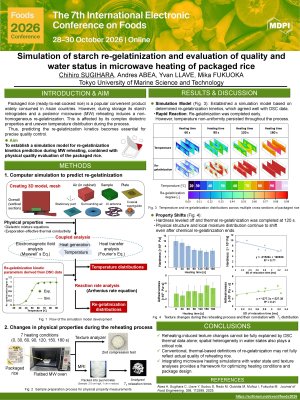
[Introduction] Pre-cooked packaged rice is widely consumed in Japan and in Asian countries as ready-to-eat food after reheating, usually using a microwave (MW) oven. Then, starch is gelatinized during processing, it partially got retrograded during distribution and storage. Although MW reheating promotes starch re-gelatinization, restoring its desirable texture and eating quality, MW heating often produces non-uniform temperature distributions, leading to uneven quality within the product. This study aims to predict starch re-gelatinization progression during MW reheating and to understand the changes in physical properties and analyze their relationship using computer simulation.
[Methods] In this study, MW reheating of packaged rice (2450 MHz, 600 W, 180 s) was simulated using COMSOL Multiphysics 6.4 coupled with a starch re-gelatinization kinetic model. A conformal mesh was employed at the interface between the rotating and stationary domains of the MW oven model to ensure electromagnetic field continuity. The starch re-gelatinization process was modeled as a first-order reaction, and the kinetic parameters were determined from constant-rate heating experiments and differential scanning calorimetry (DSC) measurements of endothermic enthalpy associated with re-gelatinization. Textural properties were evaluated using a two-bite compression test with a texture analyzer. To assess water mobility, cooked rice was sampled from three locations within the container, and two-dimensional T2 weighted images of the sample cross-sections were acquired using a high-field MRI system (9.4 T).
[Results & discussions] Simulated temperature distributions and re-gelatinization profiles showed good agreement with experimental results. Texture and water-status analyses revealed that quality-related structural changes, including increased stickiness, persisted beyond the completion of starch re-gelatinization. These findings provide new insights into the mechanisms of quality development during MW reheating and may contribute to the optimization of the reheating processes and container designs for improved quality uniformity in packaged rice products.
Keywords
Microwave reheating
Packaged cooked rice
Re-gelatinization
Quality evaluation
Poster
Foods poster sugihara final ver..pdf
Computer simulation of ohmic heating of a heterogeneous model food with an irregular geometry
Impact of Bioactive Absorbent Membranes on Spoilage Indicators and Shelf-Life of Refrigerated Meat