Event submissions
Published
This submission belongs to the session A. AI, Technology & Engineering in Food of the event The 7th International Electronic Conference on Foods
Published date
23 Oct, 2026
Academic Editor
 Nazimah Hamid
Citation
Analia Cecilia Colletti, Sergio Ramón Vaudagna, Gabriela Inés Denoya, A digital twin approach for enzymatic browning and shelf-life prediction in postharvest bananas using deep learning, in Proceedings of The 7th International Electronic Conference on Foods, 28 October–30 October 2026, MDPI: Basel, Switzerland
Share
Email
Facebook
Twitter
LinkedIn
A digital twin approach for enzymatic browning and shelf-life prediction in postharvest bananas using deep learning

Analia Cecilia Colletti 1,2
Sergio Ramón Vaudagna 1,2,3
Gabriela Inés Denoya 1,2,3
1. Institute of Food Technology, National Institute of Agricultural Technology (INTA), Hurlingham, B1686IGC, Argentina.
2. Institute for Sustainable Food Systems Science and Technology (ICyTeSAS) INTA-CONICET, Hurlingham, B1686IGC, Argentina.
3. National Scientific and Technical Research Council (CONICET), Ciudad Autónoma de Buenos Aires, C1425FQB, Argentina.
Abstract
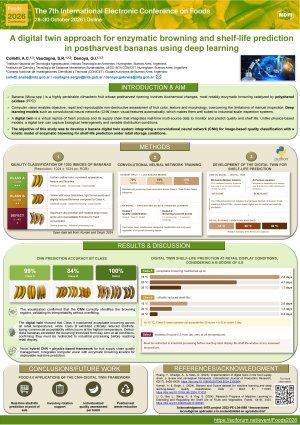
Banana (Musa spp.) is a climacteric fruit with high postharvest perishability driven by enzymatic browning catalyzed by polyphenol oxidase (PPO). This study aimed to develop a digital twin system integrating a convolutional neural network (CNN) for image-based quality classification with a kinetic model of enzymatic browning for shelf-life prediction under retail storage conditions. A dataset of 1203 banana images (1024 x 1024 px) at consumption maturity (Class A: “uniform color, appearance and firmness”; Class B: "yellow color with small imperfections, light brown spots and slightly less firmness compared to class A”; Defect: “significant discoloration with multiple large brown spots and unacceptable firmness for consumption”) was used to train an EfficientNet-B3 with transfer learning, featuring a dual output: quality classification and continuous browning score (B-score “0: without browning” – “1: maximum browning”). This score initialized a Michaelis–Menten kinetic model coupled with an Arrhenius equation (Km: 3.0 mM; Ea: 95.3 kJ/mol) simulating PPO-mediated browning dynamics over time, assuming free contact between the enzyme and the substrate. Retail conditions of 15, 20, and 30 °C at 67% RH were assessed. The CNN achieved 95.0% accuracy (MAE: 0.063). The digital twin showed that Class A bananas maintained acceptable browning (B-score: 0.5) for 7.0, 4.7, and 1.7 days at 15, 20, and 30 °C, respectively. Class B showed critically reduced shelf-life (B-score: 0.5) of 2.0, 1.2, and 0.4 days at 15, 20, and 30 °C, respectively, with commercial acceptability lost (B-score > 0.8) in under 1 day at 30 °C. Defect class bananas exceeded a B-score of 0.5 from day zero at all temperatures, confirming they must be redirected to industrial processing before reaching retail display. This CNN–digital twin framework is a novel food 4.0 tool for individualized real time shelf-life prediction at the point of sale, supporting inventory rotation, waste reduction, and quality management in the fruit supply chain.
Keywords
Artificial intelligence
postharvest quality
convolutional neural networks
polyphenol oxidase
Poster
Poster_Colletti Analia_sciforum-197904.pdf
Impact of Bioactive Absorbent Membranes on Spoilage Indicators and Shelf-Life of Refrigerated Meat
Computational Characterization of a Promising Region in Fresh Pasta Using Mixture Design and Constrained Simulation