Event submissions
Published
This submission belongs to the session A. AI, Technology & Engineering in Food of the event The 7th International Electronic Conference on Foods
Published date
23 Oct, 2026
Academic Editor
 Nazimah Hamid
Citation
Claudia Fernanda Vargas-Lara, Jesús Guadalupe Pérez-Flores, Laura García-Curiel, Justyna Cybulska, Emmanuel Pérez-Escalante, Elizabeth Contreras-López, Israel Oswaldo Ocampo-Salinas, Marisa Rivera-Arredondo, Computational Characterization of a Promising Region in Fresh Pasta Using Mixture Design and Constrained Simulation, in Proceedings of The 7th International Electronic Conference on Foods, 28 October–30 October 2026, MDPI: Basel, Switzerland
Share
Email
Facebook
Twitter
LinkedIn
Computational Characterization of a Promising Region in Fresh Pasta Using Mixture Design and Constrained Simulation

Claudia Fernanda Vargas-Lara 1

Jesús Guadalupe Pérez-Flores 1,2,3
Laura García-Curiel 2

Justyna Cybulska 4
Emmanuel Pérez-Escalante 1
Elizabeth Contreras-López 1
Israel Oswaldo Ocampo-Salinas 1
Marisa Rivera-Arredondo 5
1. Academic Area of Chemistry, Institute of Basic Sciences and Engineering, Autonomous University of the State of Hidalgo, Carretera Pachuca-Tulancingo km 4.5, Mineral de la Reforma, Hidalgo, 42184, Mexico.
2. Academic Area of Nursing, Institute of Health Sciences, Autonomous University of the State of Hidalgo, Circuito Ex Hacienda La Concepción S/N, Carretera Pachuca-Actopan, San Agustín Tlaxiaca, Hidalgo, 42060, Mexico.
3. Celaya Institute of Technology, National Technological Institute of Mexico, Antonio García Cubas Pte. #600, corner of Av. Tecnológico, P.O. Box 57, Celaya, Guanajuato, 38010, Mexico.
4. Institute of Agrophysics, Polish Academy of Sciences, Doświadczalna 4, 20-290, Lublin, Poland.
5. Agri-Food Academic Area, Technological University of Southwestern Guanajuato, Carretera Valle de Santiago-Huamimaro km 1.2, Colonia 20 de Noviembre, Valle de Santiago, Guanajuato, 38400, Mexico
Abstract
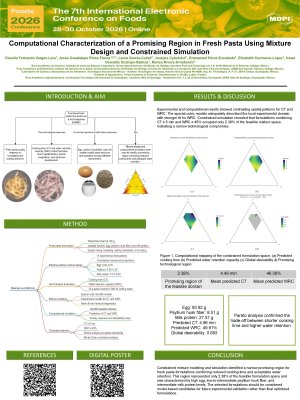
INTRODUCTION: Functional fresh pasta formulation involves a constrained compositional problem in which improving cooking performance may compromise hydration-related quality. This study characterized the technological design space of fresh pasta enriched with egg, psyllium husk fiber, and milk protein, ingredients that influence pasta structure and hydration behavior, using computational screening to support formulation decisions.
METHODS: Wheat flour was kept constant, whereas egg (x1), psyllium husk fiber (x2), and milk protein (x3) were varied using an extreme-vertices mixture design within predefined bounds. Cooking time (CT) and water retention capacity (WRC) were experimentally determined for 11 formulations. Both responses were modeled using Scheffé-type special cubic equations and projected over 100,000 constrained random mixtures. The simulated domain was examined through ternary response maps, global desirability, Pareto analysis, and a threshold-based criterion defined as CT ≤ 5 min and WRC ≥ 45%. Monte Carlo coefficient uncertainty was used to contextualize candidate selection.
RESULTS: CT and WRC displayed contrasting spatial patterns, confirming that short cooking time and high water retention were not maximized in the same region. The threshold-based promising region represented only 2.38% of the feasible domain, indicating a narrow technological compromise. This region was characterized by high egg content, low-to-intermediate psyllium husk fiber, and intermediate milk protein levels, with a mean predicted CT of 4.49 min and WRC of 46.39%. The top-ranked candidate contained 83.92 g egg, 8.51 g psyllium husk fiber, and 27.57 g milk protein in the variable fraction, with a predicted CT of 4.96 min and WRC of 49.91%.
CONCLUSIONS: A restricted but promising formulation region combining reduced cooking time and acceptable water retention capacity was identified within the constrained mixture space. The integrated computational workflow supported hypothesis testing and the selection of model-based candidates for future validation, providing a transparent screening framework rather than a final optimization outcome.
Keywords
Constrained simulation
desirability
Pareto
metamodels
optimization
validation.
Poster
Foods poster template-6aa0dcbaf0d8d_pasta.pdf
A digital twin approach for enzymatic browning and shelf-life prediction in postharvest bananas using deep learning
Influence of Pretreatment and Agro-ecological Origin on the Solar Drying Kinetics and Moisture Diffusivity of Vernonia amygdalina Vegetable.