Event submissions
Published
This submission belongs to the session A. AI, Technology & Engineering in Food of the event The 7th International Electronic Conference on Foods
Published date
23 Oct, 2026
Academic Editor
 Nazimah Hamid
Citation
Evangelia Koumoutsi, Aikaterini-Artemis Agiomavriti, Athanasios I. Gelasakis, Jolanta Wawrzyniak, Efstathios Panagou, Rapid and non-invasive monitoring of natural black olive fermentation through UV–Vis spectroscopy coupled with PCA-ANN modelling, in Proceedings of The 7th International Electronic Conference on Foods, 28 October–30 October 2026, MDPI: Basel, Switzerland
Share
Email
Facebook
Twitter
LinkedIn
Rapid and non-invasive monitoring of natural black olive fermentation through UV–Vis spectroscopy coupled with PCA-ANN modelling

Evangelia Koumoutsi 1

Aikaterini-Artemis Agiomavriti 2,3

Athanasios I. Gelasakis 2
Jolanta Wawrzyniak 4

Efstathios Panagou 1
1. Laboratory of Microbiology and Biotechnology of Foods, Department of Food Science and Human Nutrition, School of Food and Nutritional Sciences, Agricultural University of Athens, Iera Odos 75, 11855 Athens, Greece
2. Laboratory of Anatomy and Physiology of Farm Animals, Department of Animal Science, School of Animal Biosciences, Agricultural University of Athens, Iera Odos 75, Athens, Greece, GR-11855
3. R&D Department, TCB Avgidis Automations S.A., Athens, Greece, GR-11744
4. Faculty of Food Science and Nutrition, Poznań University of Life Sciences, Wojska Polskiego 31, 60-624 Poznań, Poland
Abstract
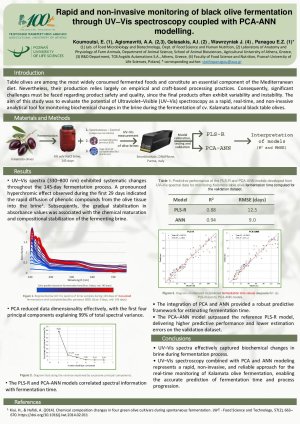
Table olives are among the most widely consumed fermented foods and constitute an essential part of the Mediterranean diet. Nevertheless, their production is still based on empirical and craft-based processing practices. As a result, significant challenges must be faced regarding product safety and quality, since the final products often exhibit variability and instability. The aim of this study was to evaluate the efficacy of UV–Vis spectroscopy as a rapid, real-time, and non-invasive tool for monitoring biochemical changes in brine during the fermentation of cv. Kalamata natural black table olives. For this purpose, olives were processed according to industrial practice in 7% (w/v) NaCl brine for 145 days. Brine samples were routinely collected and UV–Vis spectra were collected in the range 330-800 nm. The acquired spectral data were initially subjected to principal components analysis for dimensionality reduction. The scores of the first four principal components explaining 99% of the variability of the original dataset were further used as input variables for an artificial neural network (ANN) model to correlate spectral information with fermentation time. The predictive performance of the ANN was further compared with a Partial Least Squares Regression (PLS-R) model developed on the same dataset, composed of training and validation subsets. Results demonstrated that the ANN model achieved high predictive accuracy reflected by relatively high values of R2 (0.94) and low values of RMSE (9.0 days) computed for validation subset. These values were more satisfactory than those obtained by the PLS-R model that was used as reference approach (R2 = 0.88 and RMSE = 12.5 days) for the validation subset. Overall, the findings of the study provided promising perspectives for the use of UV–Vis spectroscopy combined with chemometric modeling, as a rapid and non-invasive analytical approach to monitor the fermentation of table olives.
Keywords
table olives
fermentation
Kalamata variety
spectroscopy
Artificial Neural Networks
Machine Learning
Poster
Machine Learning on table olive fermentation - Final version.pdf
Design and evaluation of a coaxial extrusion system for alginate-based 3d food printing
Dynamic redistribution and phase transition of solid particles in emulsion droplets