Event submissions
Published
This submission belongs to the session A. AI, Technology & Engineering in Food of the event The 7th International Electronic Conference on Foods
Published date
23 Oct, 2026
Academic Editor
 Nazimah Hamid
Citation
Murlykina Natalia, Olena Upatova, Study of the Functional and Technological Properties of Gluten-Free Raw Materials for New Chocolate Muffins, in Proceedings of The 7th International Electronic Conference on Foods, 28 October–30 October 2026, MDPI: Basel, Switzerland
Share
Email
Facebook
Twitter
LinkedIn
Study of the Functional and Technological Properties of Gluten-Free Raw Materials for New Chocolate Muffins

Murlykina Natalia 1,2
Olena Upatova 1
1. Department of Chemistry, Biochemistry, Microbiology and Hygiene of Nutrition, State Biotechnological University, 61051 Kharkiv, Ukraine
2. Department of Organic Chemistry and Molecular Materials, V.N. Karazin Kharkiv National University, Svobody Sq., 4, 61022 Kharkiv, Ukraine
Abstract
The largest segment of the gluten-free products market is represented by flour confectionery products. Among them, muffins occupy a special place due to their versatility, compact format, rapid preparation, and high sensory appeal. Chocolate muffins are particularly popular among consumers; however, their adaptation to gluten-free technology remains challenging.
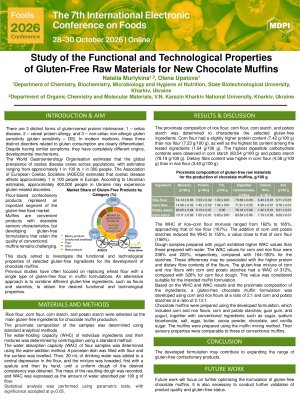
The study aimed to investigate the functional and technological properties of gluten-free raw materials for the development of new chocolate muffins. To evaluate the hydration ability of gluten-free ingredients during dough mixing, the water-holding capacity (WHC) of different raw materials and mixtures was determined. The WHC values of rice and corn flour mixtures ranged from 162 to 165%, approaching the value of rice flour (167%). The addition of corn and potato starches reduced the WHC to 155%, which was close to the value of corn flour (156%).
The water absorption capacity (WAC) of dough samples prepared with yogurt exceeded the corresponding values obtained with water. Corn and rice flours demonstrated higher WAC values (236% and 222%, respectively) than starches (164–180%) due to their higher protein and dietary fiber contents. The gluten-free mixture containing corn and rice flours together with corn and potato starches showed a WAC of 312%, which was slightly lower than that of corn flour dough (326%) but sufficient to ensure desirable functional-technological and structural-mechanical properties of muffins.
Based on the obtained WHC and WAC values and the chemical composition of the raw materials, a gluten-free formulation for chocolate muffins was developed using corn and rice flours (2:1) and corn and potato starches (2.13:1.00). The developed product may expand the range of gluten-free confectionery products intended for consumers with celiac disease and gluten intolerance.
Keywords
gluten-free raw materials
gluten-free mixtures
muffins
functional and technological properties
Poster
Foods poster template-Murlykina.pdf
Integrating computer vision descriptors with instrumental measurements to characterize color and texture evolution in whey–aguamiel cheese during refrigerated storage
Effect of different preservation treatments on membrane lipid modification and its association with enzymatic browning in fresh-cut eggplants