Event submissions
Published
This submission belongs to the session A. AI, Technology & Engineering in Food of the event The 7th International Electronic Conference on Foods
Published date
23 Oct, 2026
Academic Editor
 Nazimah Hamid
Citation
Maria Laura Lemos, Diego Gutiérrez, Antonio Sebastián Rosa, María de los Angeles Frías, Anibal Disalvo, Silvia Del Carmen Rodriguez, Effect of different preservation treatments on membrane lipid modification and its association with enzymatic browning in fresh-cut eggplants, in Proceedings of The 7th International Electronic Conference on Foods, 28 October–30 October 2026, MDPI: Basel, Switzerland
Share
Email
Facebook
Twitter
LinkedIn
Effect of different preservation treatments on membrane lipid modification and its association with enzymatic browning in fresh-cut eggplants

Maria Laura Lemos 1
Diego Gutiérrez 1,2
Antonio Sebastián Rosa 2
María de los Angeles Frías 2
Anibal Disalvo 2
Silvia Del Carmen Rodriguez 1,2
1. Instituto de Ciencia y Tecnología de los Alimentos. Facultad de Agronomía y Agroindustrias, Universidad Nacional de Santiago del Estero (UNSE), Santiago del Estero, G4200, Argentina
2. CIBAAL CONICET-UNSE, Villa El Zanjón, Santiago del Estero, Argentina
Abstract
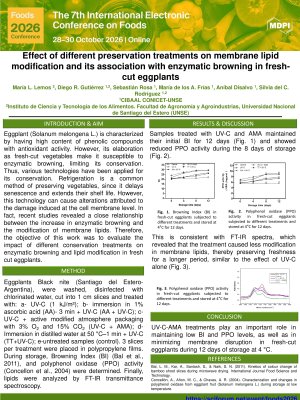
Fresh-cut eggplant quality is significantly affected by browning and lipid membrane modification may be associated with this change. In this work, browning of fresh-cut eggplants under different preservation treatments followed by changes in color and PPO enzymatic activity were related with membrane lipid modifications by FTIR spectroscopy. Eggplants Black nite variety (Santiago del Estero- Argentina), were washed, disinfected with chlorinated water (150ppm – 3min) and cut into 1-cm-thick slices and subjected to different treatments: a- UV-C (1 kJ/m²); b- immersion in 1% w/v ascorbic acid (AA) for 3 min + UV-C (AA + UV-C); c- UV-C + active modified atmosphere packaging with 3% O2 and 15% CO2 (UV-C + AMA); d- Immersion in distilled water at 50 °C – 1 min + UV-C (TT + UV-C); e-Untreated samples (control). 3 slices (180 g) per treatment were placed in plastic trays and covered with 35 µm thick bioriented polypropylene films (5.000 cm3 O2/m-2 24h-1 atm and 18.000 cm3 CO2/m-2 24h-1 atm-1 at 25 °C) in treatments a, b, d and e. Treatment c was packed in 80 µm thick high-density polyethylene bags (1.930 cm3 O2/m-2 24h-1atm-1 and 9.400 cm3 CO2/m-2 24h-1 atm-1 at 25 °C). Samples from each treatment were evaluated in triplicate during stored at 4 °C on days 0, 4, 8 and 12. Samples treated with UV-C + AMA delayed color development and reduced PPO activity during 8 days of storage. This is consistent with the infrared absorption spectra, which showed that this treatment induced less modification of the polyunsaturated fatty acids in membrane lipids, thereby maintaining freshness for a longer period. Therefore, these results suggest that the combination of UV-C and AMA plays an important role in maintaining low levels of browning and less membrane modification in fresh-cut eggplants during 12 days of storage at 4 °C.
Keywords
Fresh-cut eggplant
Lipid
Spectra infrared
Enzymatic browning.
Poster
Effect of different preservation treatments on membrane lipid modification.pdf
Study of the Functional and Technological Properties of Gluten-Free Raw Materials for New Chocolate Muffins
Performance of Novel Bio-based Absorbent Pads for Meat Packaging Applications