Event submissions
Published
This submission belongs to the session H. Food Packaging & Storage Technology of the event The 7th International Electronic Conference on Foods
Published date
23 Oct, 2026
Academic Editor
 Vitor D. Alves
Citation
Márcio Moura-Alves, Fernanda Moggi, Rui Dias-Costa, Juliana Garcia, Cristina Saraiva, Irene Gouvinhas, Performance of Novel Bio-based Absorbent Pads for Meat Packaging Applications, in Proceedings of The 7th International Electronic Conference on Foods, 28 October–30 October 2026, MDPI: Basel, Switzerland
Share
Email
Facebook
Twitter
LinkedIn
Performance of Novel Bio-based Absorbent Pads for Meat Packaging Applications

Márcio Moura-Alves 1,2
Fernanda Moggi 3

Rui Dias-Costa 4

Juliana Garcia 4,5,6

Cristina Saraiva 1,2

Irene Gouvinhas 1
1. CECAV—Centre for Studies in Animal and Veterinary Science, University of Trás-os-Montes and Alto Douro, 5000-801 Vila Real, Portugal
2. AL4AnimalS—Associate Laboratory for Animal and Veterinary Sciences, 1300-477 Lisboa, Portugal
3. School of Agrarian and Veterinary Sciences (ECAV), UTAD, 5000-801 Vila Real, Portugal.
4. Centre for the Research and Technology of Agro-Environmental and Biological Sciences (CITAB), Inov4Agro, University of Trás-os-Montes e Alto Douro, Quinta de Prados, 5000-801 Vila Real, Portugal
5. AquaValor—Centro de Valorização e Transferência de Tecnologia da Água—Associação, Rua Dr. Júlio Martins n.º 1, 5400-342 Chaves, Portugal
6. Research Centre for Active Living & Wellbeing (LiveWell), Polytechnic Institute of Bragança, 5300-253 Bragança, Portugal
Abstract
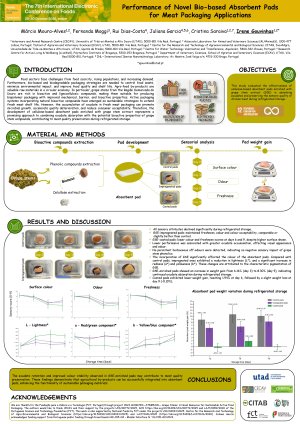
Introduction - The accumulation of exudate in fresh meat packaging promotes deterioration and reduces product acceptability. This study aimed to develop bio-based absorbent pads incorporating grape stem extracts (GSE) and evaluate their exudate absorption performance in preserving meat quality during refrigerated storage.
Methods - GSE was obtained by ultrasound-assisted extraction (4 g/20 mL, ethanol:water 50:50, 15 min, 25 °C), followed by solvent removal and freeze-drying. Absorbent pads were produced from microcrystalline cellulose using a NaOH/glycerol system, resulting in final cellulose, NaOH, and glycerol concentrations of 5, 8, and 0.5 g/100 g, respectively. The pads were enriched with GSE by surface application (0.5 g/pad), followed by storage at 4 °C for 24 h and subsequently washed to remove non-incorporated extract residues. Chicken breast samples (≈20 g) were packaged in plastic trays with pads (with and without extract), sealed with film, and stored at 4 °C for 9 days. Mass transfer was evaluated through weight variation of meat and pads, while colour parameters (L*, a*, b* and and ΔE) were determined using a colorimeter on the meat surface in direct contact with the absorbent pad.
Results and Discussion - GSE-enriched pads retained exudate throughout storage, reaching a weight gain of 8.30% at day 9. In addition, samples with GSE-enriched pads showed improved colour stability, with lower b* (18.44 vs. 20.03) and ΔE (8.70 vs. 10.09) values than samples without extract. These effects may be attributed to the presence of phenolic compounds, which have been widely associated with the inhibition of oxidative reactions in meat systems.
Conclusions – The exudate retention and improved colour stability observed in GSE-enriched pads may contribute to meat quality preservation. These findings demonstrate that agricultural by-products can be successfully integrated into absorbent pads, enhancing the functionality of sustainable packaging materials.
Keywords
Active packaging
Meat preservation
Food by-products
Poster
Poster_Irene_Carne.pdf
Effect of different preservation treatments on membrane lipid modification and its association with enzymatic browning in fresh-cut eggplants
Application of hyperspectral imaging and machine learning for the discrimination of chickpea varieties