Event submissions
Published
This submission belongs to the session A. AI, Technology & Engineering in Food of the event The 7th International Electronic Conference on Foods
Published date
23 Oct, 2026
Academic Editor
 Nazimah Hamid
Citation
Alejandro Saavedra, Juan C. Mejuto, Jesus Simal-Gandara, Gonzalo Astray, Application of hyperspectral imaging and machine learning for the discrimination of chickpea varieties, in Proceedings of The 7th International Electronic Conference on Foods, 28 October–30 October 2026, MDPI: Basel, Switzerland
Share
Email
Facebook
Twitter
LinkedIn
Application of hyperspectral imaging and machine learning for the discrimination of chickpea varieties

Alejandro Saavedra 1

Juan C. Mejuto 1

Jesus Simal-Gandara 2
Gonzalo Astray 1
1. Universidade de Vigo, Departamento de Química Física, Facultade de Ciencias, 32004 Ourense, España
2. Universidade de Vigo, Departamento de Química Analítica e Alimentaria, Facultade de Ciencias, 32004 Ourense, España
Abstract
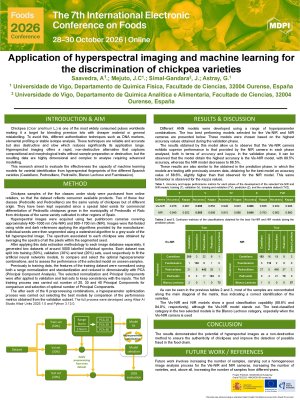
This research aimed to evaluate the capacity of hyperspectral fingerprints, coupled with machine learning models, to ensure the authenticity of chickpeas from different varieties and origins (Castellano, Pedrosillano, Pedrosillo, Blanco lechoso and Fuentesaúco)
The hyperspectral images obtained were captured using two cameras that cover an approximate range of 400–1000 nm (Vis-NIR) and 900–1700 nm (NIR), which allowed the capture of the characteristic spectral signatures of each sample (which depend on different factors such as their composition, moisture content, and structural characteristics, among others). The data was flat-fielded using the references and the algorithms facilitated by the manufacturer. Then, the spectrum for each chickpea is obtained by averaging the spectra of all its individual pixels. Both Vis-NIR and NIR databases include spectra of around 5000 individual measurements, were divided into three sets: training (for developing the models), validation (for comparting and selecting the optimal hyperparameter combinations/models), and testing (for determining the selected model’s performance with out-of-bag examples), encompassing 50%, 30% and, 20% of each dataset respectively. To determine the variety of each chickpea sample, artificial neural networks were used.
Different ANN models were developed using a range of hyperparameter combinations. The selected ANN presents, for the training, accuracy values slightly around 90% while, for the testing phase, they remain close to this value. The results demonstrated the potential of hyperspectral images as a non-destructive method to ensure the authenticity of chickpeas and improve the detection of possible fraud in the food chain.
Authors thank Grant PID2023-149426OB-I00 funded by MICIU/AEI/ 10.13039/501100011033 and by ERDF/EU, and Saavedra A. thanks to Grant PID2023-149426OB-I00 funded by MICIU/AEI/10.13039/501100011033 and by ESF+.
Keywords
Hyperspectral imaging
chickpeas
varieties
authenticity
machine learning
Poster
Poster_Saavedra et al.pdf
Performance of Novel Bio-based Absorbent Pads for Meat Packaging Applications
STORAGE STABILITY ASSESSMENT OF APPLE (MALUS DOMESTICA L.) IN RESPONSE TO DIFFERENT EDIBLE COATINGS