Event submissions
Published
This submission belongs to the session H. Food Packaging & Storage Technology of the event The 7th International Electronic Conference on Foods
Published date
23 Oct, 2026
Academic Editor
 Vitor D. Alves
Citation
Kimberly Berrazueta-Jaramillo, Translational Application of Chia (Salvia hispanica) and Nopal (Opuntia ficus-indica) Mucilage-Based Edible Coatings for the Postharvest Preservation of Cherry Tomato and Carrot, in Proceedings of The 7th International Electronic Conference on Foods, 28 October–30 October 2026, MDPI: Basel, Switzerland
Share
Email
Facebook
Twitter
LinkedIn
Translational Application of Chia (Salvia hispanica) and Nopal (Opuntia ficus-indica) Mucilage-Based Edible Coatings for the Postharvest Preservation of Cherry Tomato and Carrot

Kimberly Berrazueta-Jaramillo 1
1. Plant Translational Research Group, Ikiam Amazonian Regional University, Km 7 Via Muyuna, Tena, Napo, Ecuador.
Abstract
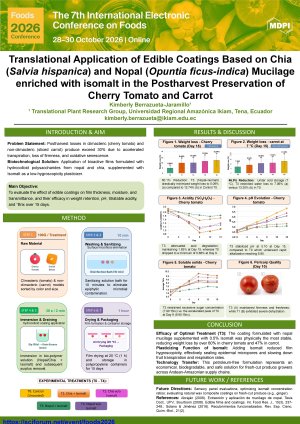
Introduction: Postharvest losses (~23%) arise from physicochemical and microbial decay. Edible biopolymer coatings offer sustainable alternatives to synthetic waxes, yet their efficacy depends critically on water-vapor permeability (WVP) and water activity (aw). This translational study formulated coatings from chia and nopal mucilages, with/without Isomalt as a matrix modifier/aw reducer, for climacteric (cherry tomato) and non-climacteric (carrot) produce.
Methodology: Five groups (control, Chia, Chia+Isomalt, Nopal, Nopal+Isomalt) were stored at 25±1 °C/65±5% RH for 15 days. Films were characterized for barrier properties; weight loss (WL), TSS (°Brix), pH, and titratable acidity (TA) were monitored every 3 days and analyzed via two-way ANOVA/Tukey's (p<0.05).
Results: Isomalt reduced nopal film WVP by 32% (p<0.05) via hydrogen-bond networking, unlike chia films which exhibited structural micro-fractures and higher hygroscopicity. In vivo, Nopal+Isomalt outperformed all treatments, restricting tomato WL to 5.2±0.3% (control: 15.7±0.6%), maintaining TA (0.48±0.02% vs. 0.31±0.03%) and pH (4.1±0.1). For carrots, WL was 8.3±0.4% (control: 22.5±1.1%), with stable pH (6.1±0.1). TSS remained stable at 5.9±0.2 °Brix (tomato) and 7.2±0.3 °Brix (carrot), versus control fluctuations >±2.0 °Brix (p<0.05). This high stability indicates an effective reduction in the respiration rate and metabolic carbon consumption of the treated tissues. Synergy arises from nopal's galacturonic acid (enhancing continuity) and Isomalt's aw-depression, improving moisture/O2 barriers without sacrificing transparency.
Conclusion: Tailoring nopal mucilage with Isomalt effectively delays senescence and moisture loss across distinct metabolic models, validating its scalability as an eco-friendly postharvest technology with translational supply-chain applications. Furthermore, these bio-polymeric systems demonstrate an outstanding potential to replace commercial synthetic coatings, representing a viable, high-throughput, and cost-effective strategy to mitigate agricultural economic losses while strictly preserving fresh-like organoleptic attributes during retail distribution.
Keywords
Edible coatings
Nopal mucilage
Isomalt
Hydrocolloids
Postharvest preservation
Translational plant science.
Poster
Poster - Foods - Berrazueta.pdf
From Laboratory Films to Food-Contact Packaging: A PRISMA 2020 Systematic Review and Translational Maturity Assessment of Bacterial Cellulose/Nanocellulose
Active packaging as a growing trend in food industry: antimicrobial compounds in biodegradable films.