Event submissions
Published
This submission belongs to the session H. Food Packaging & Storage Technology of the event The 7th International Electronic Conference on Foods
Published date
23 Oct, 2026
Academic Editor
 Vitor D. Alves
Citation
Paulina Brzęcka, Agnieszka Richert, Magdalena Lewandowska, Natalia Hejda, Active packaging as a growing trend in food industry: antimicrobial compounds in biodegradable films., in Proceedings of The 7th International Electronic Conference on Foods, 28 October–30 October 2026, MDPI: Basel, Switzerland
Share
Email
Facebook
Twitter
LinkedIn
Active packaging as a growing trend in food industry: antimicrobial compounds in biodegradable films.

Paulina Brzęcka 1

Agnieszka Richert 1,2
Magdalena Lewandowska 1
Natalia Hejda 1
1. Department of Genetics, Faculty of Biological and Veterinary Sciences, Nicolaus Copernicus University in Toruń, Gagarina 11, 87-100 Toruń, Poland
2. Institute of Advanced Studies, Nicolaus Copernicus University in Toruń), Wileńska 4, 87-100 Toruń, Poland
Abstract
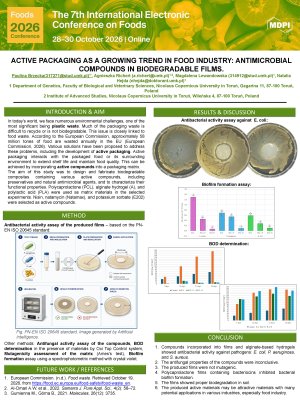
Plastic waste remains a major environmental challenge due to its environmental persistence and the release of microplastics, which may negatively affect human health, wildlife, and ecosystems. Consequently, increasing attention is being paid to the development of biodegradable materials for active food packaging. Active packaging systems are designed to extend the shelf life of food products and maintain their quality by releasing or absorbing selected compounds within the package environment. Such systems may also help reduce the growth of foodborne microorganisms responsible for food spoilage and potential safety risks.
The aim of this study was to develop biodegradable antimicrobial films containing selected antimicrobial agents, including nisin, natamycin and the conventional preservative potassium sorbate (E202). Antimicrobial systems were prepared using polycaprolactone (PCL), polylactide (PLA), and alginate-based hydrogels as carrier matrices functionalized with these compounds. The materials were evaluated for antimicrobial activity, inhibition of biofilm formation, mutagenic potential, phototoxicity and biodegradation under soil conditions. The developed systems showed strong antibacterial activity and limited antifungal effects. Significant inhibition of biofilm formation confirmed their antimicrobial functionality. No mutagenic potential was detected, suggesting a favorable safety profile. Biodegradation studies revealed matrix-dependent behavior, with alginate-based materials degrading considerably faster than PCL-based systems. These findings demonstrate the potential of antimicrobial-agent-functionalized biodegradable materials as sustainable active packaging solutions. Their selective antimicrobial activity, safety, and biodegradability make them promising candidates for future food-packaging applications. However, further in vivo studies are required to assess cytotoxicity and support practical implementation.
Results for potassium sorbate-containing materials are still ongoing; nevertheless, preliminary data indicate promising antimicrobial activity and acceptable phytotoxicity profiles.
Financed by the funds of the Minister of Science and Higher Education under the program “Excellence Initiative – Research University” for the Priority Research Team at Nicolaus Copernicus University in Toruń, “EPIBIOMAT Research Group – Epibiocompatible Materials for Medicine and One Health”.
Keywords
active packaging
antimicrobial activity
biodegradable films
biofilms
bacteriocins
nisin
natamycin
potassium sorbate
food packaging
bioengineering
Poster
Foods poster_Paulina Brzecka.pdf
Translational Application of Chia (Salvia hispanica) and Nopal (Opuntia ficus-indica) Mucilage-Based Edible Coatings for the Postharvest Preservation of Cherry Tomato and Carrot
Waste to packaging: Novel Edible Films from Whey-Derived Microbial Protein incorporated with cellulose