Event submissions
Published
This submission belongs to the session H. Food Packaging & Storage Technology of the event The 7th International Electronic Conference on Foods
Published date
23 Oct, 2026
Academic Editor
 Vitor D. Alves
Citation
Danai Ioanna Koukoumaki, Eowyn Tohme, Dimitris Sarris, Waste to packaging: Novel Edible Films from Whey-Derived Microbial Protein incorporated with cellulose, in Proceedings of The 7th International Electronic Conference on Foods, 28 October–30 October 2026, MDPI: Basel, Switzerland
Share
Email
Facebook
Twitter
LinkedIn
Waste to packaging: Novel Edible Films from Whey-Derived Microbial Protein incorporated with cellulose

Danai Ioanna Koukoumaki 1
Eowyn Tohme 1

Dimitris Sarris 1
1. Department of Food Science and Nutrition, University of the Aegean, Myrina, Lemnos, Greece
Abstract
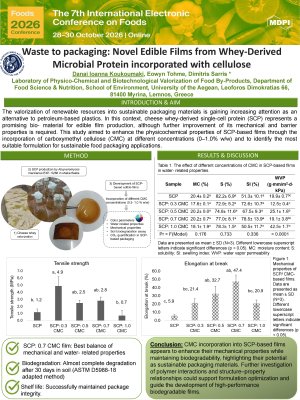
The development of sustainable packaging materials from renewable resources has attracted increasing attention as an alternative to conventional petroleum-based plastics. In this study, single-cell protein (SCP) obtained through the biotechnological valorization of cheese whey, the major byproduct of the dairy industry, was utilized as the primary biopolymer for the production of novel edible films. To enhance the physicochemical properties of the films, cellulose was incorporated at concentrations of 0.3, 0.5, 0.7, and 1.0% (w/w).
The effect of cellulose addition on film properties was evaluated through physicochemical and mechanical characterization. Results demonstrated that cellulose significantly influenced film performance. In particular, elongation at break increased substantially with cellulose incorporation, reaching values up to eight times higher than the control at 0.7% cellulose, indicating improved flexibility and mechanical behavior. Furthermore, the incorporation of 0.3% cellulose significantly reduced water vapor permeability, suggesting enhanced barrier properties against moisture transfer. These findings indicate that cellulose incorporation can effectively tailor the functionality of SCP-based films and improve their suitability for food-packaging applications.
The most promising formulations will be further evaluated as packaging materials for bakery products. Ongoing studies include the assessment of biodegradation behavior under soil conditions and the monitoring of gas composition (O₂ and CO₂) within packaged food systems in order to investigate package performance and environmental sustainability. Overall, the proposed approach combines dairy byproduct valorization with the development of biodegradable packaging materials, contributing to circular economy strategies and sustainable food packaging solutions.
Keywords
single cell protein
bio-polymers
waste valorization
improved mechanical properties
packaging
Poster
Final Poster_Foods 2026.pdf
Active packaging as a growing trend in food industry: antimicrobial compounds in biodegradable films.
Sodium Pyrithione-Modified PCL/PLA Blends as Active Antimicrobial Biodegradable Packaging Materials