Event submissions
Published
This submission belongs to the session H. Food Packaging & Storage Technology of the event The 7th International Electronic Conference on Foods
Published date
23 Oct, 2026
Academic Editor
 Vitor D. Alves
Citation
Valter FR Martins, Manuela E Pintado, Rui MSC Morais, Alcina MMB Morais, Edible Coatings Enriched with Extracts from Fucus spiralis and Limnospira sp. for Sustainable Postharvest Preservation of Strawberries, in Proceedings of The 7th International Electronic Conference on Foods, 28 October–30 October 2026, MDPI: Basel, Switzerland
Share
Email
Facebook
Twitter
LinkedIn
Edible Coatings Enriched with Extracts from Fucus spiralis and Limnospira sp. for Sustainable Postharvest Preservation of Strawberries

Valter FR Martins 1

Manuela E Pintado 1

Rui MSC Morais 1

Alcina MMB Morais 1
1. Universidade Católica Portuguesa, CBQF - Centro de Biotecnologia e Química Fina – Laboratório Associado, Escola Superior de Biotecnologia, Rua Diogo Botelho 1327, 4169-005 Porto, Portugal
Abstract
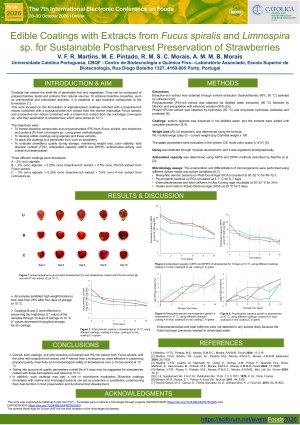
The development of sustainable preservation technologies is increasingly important for reducing postharvest losses of highly perishable fruits. This study investigated alginate-based edible coatings enriched with bioactives extracted from the marine macroalga Fucus spiralis and the microalga Limnospira sp. and evaluated their effectiveness in maintaining strawberry quality during refrigerated storage at 10 °C over 10 days. The coatings (2% w/v alginate) incorporated bioactive-rich extracts (0.25% w/v) combined with polysaccharide- or protein-rich fractions (0.5% w/v), obtained through environmentally friendly extraction processes (e.g. 90% hydroethanolic maceration assisted by ultrasound, and 300 W microwave hydrodiffusion and gravity-assisted extraction). Quality parameters including weight loss, color stability (hue and chroma), antioxidant capacity (ABTS and DPPH assays), total phenolic content (TPC), antimicrobial activity, and overall fruit deterioration were monitored throughout storage.
Both algae-derived formulations contributed to delaying quality degradation compared with uncoated fruit. Antioxidant activity in coated strawberries declined during storage but remained measurable throughout, with ABTS values decreasing from 20.78±2.04 to 13.24±0.57 μmol TE/100 mg DW for Limnospira and from 21.43±0.90 to 12.88±0.39 μmol TE/100 mg DW for Fucus spiralis, and DPPH values declining from 7.12±0.05 to 4.07±0.22 μmol TE/100 mg DW for Limnospira and from 9.18±0.66 to 4.76±0.48 μmol TE/100 mg DWfor Fucus spiralis over 10 days, despite a general reduction in TPC of 21.2% for F. spiralis and 29.8% for Limnospira. Microbial analyses revealed that coatings containing Fucus spiralis or Limnospira sp. extracts offered only moderate protection against spoilage fungi, yeasts, and bacteria, with performance varying between formulations; in some cases, microbial proliferation was not fully suppressed.
Although the preservation performance differed between the algae-derived formulations and a comparator exhausted olive pomace-based coating, the incorporation of Fucus spiralis and Limnospira sp. extracts demonstrated the potential of marine biomass as a renewable source of functional ingredients for edible coatings. These findings support the valorization of algal resources in sustainable food-packaging and in extending the shelf life of fresh produce.
Keywords
Limnospira microalga
Fucus spiralis macroalga
strawberry
alginate
bioactives
total phenolic content
antioxidant activity
antimicrobial activity
Poster
Poster 7th IECF_Morais.pdf
Sodium Pyrithione-Modified PCL/PLA Blends as Active Antimicrobial Biodegradable Packaging Materials
From Citrus Processing Residues to Functional Edible Coatings: Waste-Derived Pickering Systems for Sustainable Food Packaging and Fresh-Cut Fruit Preservation.