Event submissions
Published
This submission belongs to the session H. Food Packaging & Storage Technology of the event The 7th International Electronic Conference on Foods
Published date
23 Oct, 2026
Academic Editor
 Vitor D. Alves
Citation
Raquel Lucas-Gonzalez, José A. Pérez-Alvarez, Rachel Lebrouster, Juana Fernández-López, Manuel Viuda-Martos, Effect of Biodegradable PLA–Chitosan–Pomace Extract Films as Slice Separators on the Quality and Shelf Life of Gouda Cheese, in Proceedings of The 7th International Electronic Conference on Foods, 28 October–30 October 2026, MDPI: Basel, Switzerland
Share
Email
Facebook
Twitter
LinkedIn
Effect of Biodegradable PLA–Chitosan–Pomace Extract Films as Slice Separators on the Quality and Shelf Life of Gouda Cheese

Raquel Lucas-Gonzalez 1

José A. Pérez-Alvarez 2
Rachel Lebrouster 3

Juana Fernández-López 2

Manuel Viuda-Martos 1
1. Institute for Agri-Food and Agri-Environmental Research and Innovation (CIAGRO-UMH), Miguel Hernández University, 03312, Orihuela, Alicante, Spain.
2. IPOA Research Group, Agro-Food Technology Department, Centro de Investigación e Innovación Agroalimentaria y Agroambiental (CIAGRO-UMH), Miguel Hernández University, 03312 Alicante, Spain.
3. Centre Technique Industriel de la Plasturgie et des Composites (IPC), 01100 Bellignat, France
Abstract
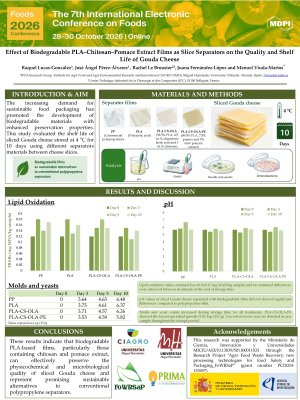
The increasing demand for sustainable food packaging has promoted the development of biodegradable materials with enhanced preservation properties. This study evaluated the shelf life of sliced Gouda cheese stored at 4 °C for 10 days using different separators materials between cheese slices. Four separator films were assessed: commercial polypropylene (PP), polylactic acid (PLA), 92.5% PLA, 4.5 wt.% oligomeric lactic acid and 3 wt.% chitosan (PLA-CS-OLA), and 89.5% PLA, 7.5% premix and 3% olive pomace extract (PLA-CS-OLA-PE). Lipid oxidation using the TBARs assay, pH, moulds and yeast counts, and Enterobacteriaceae were monitored throughout storage time. Lipid oxidation values remained low in all treatments, ranging from 0.14 to 0.17 mg malondialdehyde/kg sample at the end of storage period with no statistical differences (p > 0.05) between samples. Regarding pH, cheese samples separated with biodegradable films did not show statistical differences (p > 0.05), at the end of storage period with PP used as control with values ranged between 5.59 and 5.75. Microbiological analyses revealed a progressive increase in mould and yeast counts during storage for all treatments. However, the PLA-CS-OLA-PE film resulted in the lowest microbial growth at the end of storage (5.82 log CFU/g), compared with PP (6.48 log CFU/g), PLA (6.01 log CFU/g), and PLA-CS-OLA (6.26 log CFU/g) whilst Enterobacteriaceae were not detected in any sample throughout the storage period. These results indicate that biodegradable PLA-based films, particularly those containing chitosan and pomace extract, can effectively preserve the physicochemical and microbiological quality of sliced Gouda cheese and represent promising sustainable alternatives to conventional polypropylene separators.
Keywords
Polylactic acid
Olive Pomace
Shelf life
Cheese,
Poster
Poster Cheese.pdf
From Citrus Processing Residues to Functional Edible Coatings: Waste-Derived Pickering Systems for Sustainable Food Packaging and Fresh-Cut Fruit Preservation.
Preserved hepatic, renal, and intestinal antioxidant enzyme activity in mice supplemented with an olive pomace extract