Event submissions
Published
This submission belongs to the session B. Nutritional & Functional Foods of the event The 7th International Electronic Conference on Foods
Published date
23 Oct, 2026
Academic Editor
 Manuel Viuda-Martos
Citation
Eva Santos, Tiago Azevedo, Matilde Prata, Leonor Botelho, Manuel Román, Lillian Barros, Luís Félix, Paula A. Oliveira, Preserved hepatic, renal, and intestinal antioxidant enzyme activity in mice supplemented with an olive pomace extract, in Proceedings of The 7th International Electronic Conference on Foods, 28 October–30 October 2026, MDPI: Basel, Switzerland
Share
Email
Facebook
Twitter
LinkedIn
Preserved hepatic, renal, and intestinal antioxidant enzyme activity in mice supplemented with an olive pomace extract

Eva Santos 1

Tiago Azevedo 1,2,3,4
Matilde Prata 1
Leonor Botelho 1
Manuel Román 5

Lillian Barros 4

Luís Félix 1,2

Paula A. Oliveira 1,2
1. University of Trás-os-Montes and Alto Douro (UTAD), Quinta de Prados, 5000-801 Vila Real, Portugal
2. Centre for the Research and Technology of Agro-Environmental and Biological Sciences (CITAB), Institute for Innovation, Capacity Building and Sustainability of Agri-Food Production (Inov4Agro), University of Trás-os-Montes and Alto Douro (UTAD), Quinta de Prados, 5000-801 Vila Real, Portugal
3. Animal and Veterinary Research Centre (CECAV), Associate Laboratory for Animal and Veterinary Sciences (AL4AnimalS), University of Trás-os-Montes and Alto Douro, Quinta de Prados, 5000-801 Vila Real, Portugal
4. CIMO, LA SusTEC, Instituto Politécnico de Bragança, Campus de Santa Apolónia, 5300-253 Bragança, Portugal
5. Isanatur Spain SL, 31100 Navarra, Spain
Abstract
Olive pomace (OP), a semi-solid by-product of olive oil production, is rich in phenolic compounds with recognized antioxidant and anti-inflammatory properties, supporting its potential valorization as a sustainable bioactive ingredient. However, given the relevance of antioxidant enzymes as markers of tissue redox homeostasis, assessing their activity in vivo is an important step before further exploring the functional application of OP extract. This study aimed to evaluate hepatic, renal, and intestinal antioxidant enzyme responses in female mice (Mus musculus) supplemented with an OP extract.
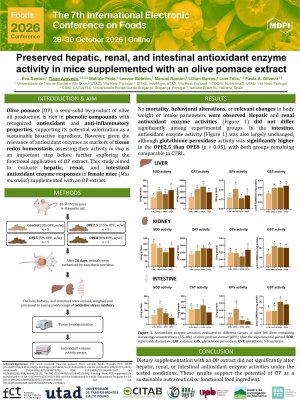
All experimental procedures were conducted in accordance with Directive 2010/63/EU and approved by national authorities (approval no. 014139). Twenty FVB/n female mice (6–8 months old) were randomly assigned to four groups (n=5) receiving diets containing 0% (CTRL), 2.5%, 5%, and 8% of OP extract for 28 days. Body weight, food and water intake, and wellbeing were monitored throughout the study. At the end of the study, animals were euthanized by anesthetic overdose (sodium pentobarbital) followed by cardiac puncture. Following euthanasia, liver, kidney, and intestinal samples were collected for the assessment of antioxidant enzyme activity using spectrophotometric methods, namely catalase, glutathione peroxidase, glutathione S-transferase, and superoxide dismutase.
No mortality, behavioral alterations, or relevant changes in body weight or intake parameters were observed. Hepatic and renal antioxidant enzyme activities did not differ significantly among experimental groups. In the intestine, antioxidant enzyme activity was also largely unchanged, although glutathione peroxidase activity was significantly higher in the 2.5% group than in the 8% group (p < 0.05), with both groups remaining comparable to CTRL.
In conclusion, dietary supplementation with an OP extract did not significantly alter hepatic, renal, or intestinal antioxidant enzyme activities under the tested conditions. These results support the potential of OP as a sustainable nutraceutical or functional food ingredient.
Keywords
in vivo
Mus musculus
Olea europaea
oxidative stress
phenolic compounds
Poster
Poster Foods 2026_Tiago Azevedo_Olive pomace.pdf
Effect of Biodegradable PLA–Chitosan–Pomace Extract Films as Slice Separators on the Quality and Shelf Life of Gouda Cheese
Worker Bee Larvae Powder in 3D-Printed Bioinks