Event submissions
Published
This submission belongs to the session B. Nutritional & Functional Foods of the event The 7th International Electronic Conference on Foods
Published date
23 Oct, 2026
Academic Editor
 Manuel Viuda-Martos
Citation
Shewangzaw Addisu Mekuria, Alona Tiupova, Joanna Harasym, Worker Bee Larvae Powder in 3D-Printed Bioinks, in Proceedings of The 7th International Electronic Conference on Foods, 28 October–30 October 2026, MDPI: Basel, Switzerland
Share
Email
Facebook
Twitter
LinkedIn
Worker Bee Larvae Powder in 3D-Printed Bioinks

Shewangzaw Addisu Mekuria 1,2
Alona Tiupova 1

Joanna Harasym 1,3
1. Department of Biotechnology and Food Analysis, Wroclaw University of Economics and Business, Komandorska 118/120, 53-345 Wroclaw, Poland
2. University of Gondar, P.O.Box, 196, Gondar, Ethiopia
3. Adaptive Food Systems Accelerator-Science Centre, Wrocław University of Economics and Business, Komandorska 118/120, 53-345 Wroclaw, Poland
Abstract
Introduction
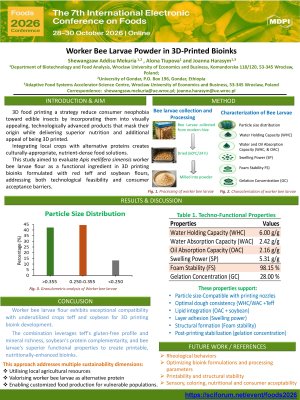
Three-dimensional food printing offers a strategic approach to reducing consumer neophobia toward edible insects by incorporating them into visually appealing, technologically advanced products that mask their origin while delivering superior nutrition and the additional appeal of being 3D printed. Integrating local crops with alternative proteins creates culturally appropriate, nutrient-dense food solutions. This study evaluates Apis mellifera simensis worker bee larvae flour as a functional ingredient in 3D printing bioinks formulated with teff and soybean flours, addressing both technological feasibility and consumer acceptance barriers. Methods: Worker bee larvae powder was characterized for particle size distribution and techno-functional properties critical for bioink formulation: water-holding capacity, water absorption capacity, oil absorption capacity, swelling power, foam stability, and gelation concentration. Bioink formulations combining bee larvae flour with teff and soybean flours were evaluated for printability and compatibility with extrusion-based 3D printing, based on rheological requirements.
Results
Particle size distribution optimal for extrusion printing was 0.250-0.355 mm (44.9%) and >0.355 mm (42.2%), compatible with standard printing nozzles. Critical printing-relevant properties demonstrated excellent printability potential: WHC 6.00 g/g and WAC 2.42 g/g facilitated optimal dough consistency when combined with teff's water-binding capacity; OAC 2.16 g/g complemented soybean's lipid content; swelling power 5.31 g/g supported layer adhesion; foam stability of 98.15% contributed to structure formation; and gelation concentration of 28% enabled post-printing stabilization in composite formulations.
Conclusion
Worker bee larvae flour exhibits exceptional compatibility with underutilized crops, teff and soybean, for 3D printing bioink development. The combination leverages teff's gluten-free profile and mineral richness, soybean's protein complementarity, and bee larvae's superior functional properties to create printable, nutritionally enhanced bioinks. This approach addresses multiple sustainability dimensions: utilizing local agricultural resources, valorizing worker bee larvae as an alternative protein source, and enabling customized food production for vulnerable populations.
Keywords
3D printing
Soybean
Techno-functional
Teff
Worker bee larvae.
Poster
Shewangzaw_3D.pdf
Preserved hepatic, renal, and intestinal antioxidant enzyme activity in mice supplemented with an olive pomace extract
Worker Bee Larvae as a Novel Edible Insect – Advancing EU Novel Food Authorization