Event submissions
Published
This submission belongs to the session B. Nutritional & Functional Foods of the event The 7th International Electronic Conference on Foods
Published date
23 Oct, 2026
Academic Editor
 Manuel Viuda-Martos
Citation
Shewangzaw Addisu Mekuria, Agnieszka Orkusz, Joanna Harasym, Worker Bee Larvae as a Novel Edible Insect – Advancing EU Novel Food Authorization, in Proceedings of The 7th International Electronic Conference on Foods, 28 October–30 October 2026, MDPI: Basel, Switzerland
Share
Email
Facebook
Twitter
LinkedIn
Worker Bee Larvae as a Novel Edible Insect – Advancing EU Novel Food Authorization

Shewangzaw Addisu Mekuria 1,2

Agnieszka Orkusz 1

Joanna Harasym 1,3
1. Department of Biotechnology and Food Analysis, Wroclaw University of Economics and Business, Komandorska 118/120, 53-345 Wroclaw, Poland
2. University of Gondar, P.O.Box, 196, Gondar, Ethiopia
3. Adaptive Food Systems Accelerator-Science Centre, Wrocław University of Economics and Business, Komandorska 118/120, 53-345 Wroclaw, Poland
Abstract
Introduction
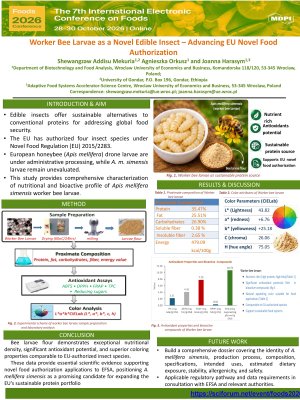
Edible insects offer sustainable alternatives to conventional proteins for addressing global food security. While the EU has authorized four insect species under Novel Food Regulation (EU) 2015/2283, the bee larvae, specifically European honey bee, Apis mellifera drone larvae, are under administrative processing. Meanwhile, Apis mellifera simensis, the honey bee larvae typical for Ethiopia, remain unevaluated despite their potential. This study provides a comprehensive characterization of the nutritional and bioactive profile of Apis mellifera simensis worker bee larvae.
Methods
Bee larvae flour was analyzed for proximate composition (protein, fat, carbohydrates, and fiber), energy value, color parameters (CIELab), and antioxidant activity (2,2′-azino-bis (3-ethylbenzothiazoline-6-sulfonic acid radical (ABTS), 2,2-diphenyl-1-picrylhydrazyl radical (DPPH), ferric reducing antioxidant power (FRAP assays), total phenolic content (TPC), and reducing sugars (DNS)).
Results
Proximate composition revealed protein 35.47%, fat 25.51%, carbohydrates 26.90%, soluble fiber 0.38%, insoluble fiber 2.65%, and energy 479.09 kcal/100g. Color values were L*=43.82, a*=+6.76, b*=+25.18, c=26.06, and h=75.05. Antioxidant activities were ABTS (4.10 mg TxE/g DM), DPPH (0.32 mg TxE/g DM), FRAP (7.79 mg FeSO₄/g DM), with TPC (2.21 mg GAE/g DM) and reducing sugars (10.72 mg glucose/g DM).
Conclusion
Bee larvae flour demonstrates exceptional nutritional density, significant antioxidant potential, and superior techno-functional properties comparable to EU-authorized insect species. These comprehensive characterization data provide essential scientific evidence to support novel food authorization applications to EFSA, positioning A. mellifera simensis as a promising candidate for expanding the EU's sustainable protein portfolio.
Keywords
Apis mellifera simensis
worker bee larvae
physicochemical
nutritional
antioxidant
Poster
Shewangzaw_Worker Bee Larvae as a Novel Edible Insect .pdf
Worker Bee Larvae Powder in 3D-Printed Bioinks
Classical, Deep, and Quantum Machine Learning for Automated Ulluco Quality Classification