Event submissions
Published
This submission belongs to the session A. AI, Technology & Engineering in Food of the event The 7th International Electronic Conference on Foods
Published date
23 Oct, 2026
Academic Editor
 Nazimah Hamid
Citation
Emerson Maximo Asto-Rodriguez, Guillermo Kemper-Vásquez, Classical, Deep, and Quantum Machine Learning for Automated Ulluco Quality Classification, in Proceedings of The 7th International Electronic Conference on Foods, 28 October–30 October 2026, MDPI: Basel, Switzerland
Share
Email
Facebook
Twitter
LinkedIn
Classical, Deep, and Quantum Machine Learning for Automated Ulluco Quality Classification

Emerson Maximo Asto-Rodriguez 1,2
Guillermo Kemper-Vásquez 3
1. Programa de Doctorado en Ingeniería Agroindustrial - Mención Transformación Avanzada de Granos y Tubérculos Andinos, Universidad Nacional del Santa, Nuevo Chimbote 02712, Perú
2. ARCAM-UNT research group, Universidad Nacional de Trujillo, Av. Juan Pablo II s/n, Trujillo 13001, Peru
3. Universidad Peruana de Ciencias Aplicadas (UPC), Av. Prolongación Primavera 2390, Monterrico, Santiago de Surco, Lima 15023, Perú
Abstract
Introduction
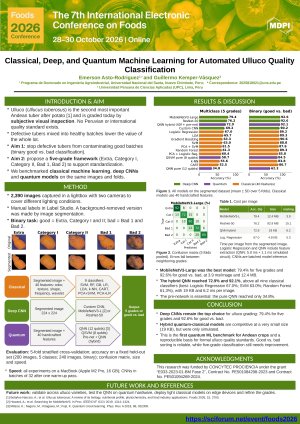
Ullucus tuberosus (ulluco) is an Andean tuber currently graded by subjective visual inspection, with no international quality standard. This study addresses two objectives: preventing defective tubers from contaminating healthy batches, and proposing a five-category grading framework to support standardization. We benchmarked classical machine learning, deep convolutional neural networks (CNNs), and quantum models for automated visual classification.
Methods
A dataset of 2,390 images was captured inside a lightbox using two cameras to capture different lighting conditions. Samples were manually labeled into five categories (Extra, Category I, Category II, Bad 1, Bad 2) using Label Studio. A background-removed version was generated via image segmentation. We extracted 40 features covering color, texture, shape, frequency, and wavelet domains. Three CNNs (Custom, MobileNetV3-Large, ResNet-50) and nine classical classifiers were trained, alongside quantum models: angle-encoding QNNs (pure 12‑qubit and hybrid with a pre‑network) and QSVMs with PCA to 8 qubits, all evaluated with 5‑fold cross‑validation.
Results and Discussion
MobileNetV3-Large achieved the best performance: 79.4% multiclass and 92.6% binary accuracy (good vs. bad), with fast inference (3.9 ms/img, 12.4 MB). The hybrid QNN reached 72.9% multiclass and 92.1% binary accuracy, outperforming all classical baselines, with 19 KB and 1.1 ms per inference. ResNet-50 scored 76.2% but was slower and larger. Logistic Regression, the best among the nine classical classifiers tested, attained 67.0%. The pure QNN performed near random (34.8%), highlighting the importance of the pre‑network in hybrid designs.
Conclusions
Deep CNNs remain the top choice for ulluco grading, but hybrid quantum‑classical models offer competitive accuracy with an extremely small footprint, suitable for edge deployment. Both objectives were met: reliable good/bad separation (92.6%) and five‑category grading (79.4%). This work provides the first quantum ML benchmark for Andean crops and a reproducible basis for formal ulluco quality standards, paving the way for automated quality control in Andean agriculture.
Keywords
Ullucus tuberosus
computer vision
quality grading
deep learning
quantum machine learning
food automation
Poster
Foods2026_Poster_Asto-Rodriguez_Ulluco_ML.pdf
Worker Bee Larvae as a Novel Edible Insect – Advancing EU Novel Food Authorization