Event submissions
Published
This submission belongs to the session C. Food Physicochemistry & Analysis of the event The 7th International Electronic Conference on Foods
Published date
26 Oct, 2026
Academic Editor
 Joana S. Amaral
Citation
Enoch Thaddaeus Quayson, Michael Ampiaw Yankson, Joshau Buer Puplampu, Fidelis C K Ocloo, Physicochemical properties of stored Ga and Fante Kenkey Aflata-mix from maize-sweet potato composite dough, in Proceedings of The 7th International Electronic Conference on Foods, 28 October–30 October 2026, MDPI: Basel, Switzerland
Share
Email
Facebook
Twitter
LinkedIn
Physicochemical properties of stored Ga and Fante Kenkey Aflata-mix from maize-sweet potato composite dough

Enoch Thaddaeus Quayson 1
Michael Ampiaw Yankson 1
Joshau Buer Puplampu 1
Fidelis C K Ocloo 2
1. Department of Biochemistry, School of Biological Sciences, College of Agriculture and Natural Sciences, University of Cape Coast, Cape Coast, Ghana
2. Department of Nuclear Agriculture and Radiation Processing, School of Nuclear and Allied Sciences, University of Ghana, Atomic Campus, P.O. Box AE-1, Atomic-Accra, Ghana
Abstract
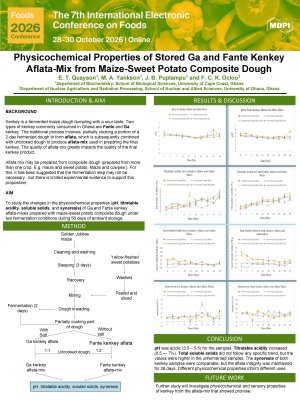
Kenkey, a staple maize dough dumpling widely consumed in Ghana, exists primarily in two forms: Ga kenkey and Fante kenkey. Traditionally, production relies on fermented maize dough, part of which is partially cooked into aflata and mixed with uncooked dough to form the aflata-mix. The integrity of this aflata-mix is critical to the quality of the final product. Recently, there has been growing interest in incorporating doughs from other crops, such as sweet potato, into composite formulations. In such cases, some practitioners suggest preparing aflata before fermentation, though no empirical evidence has validated this approach. This study aimed to evaluate the physicochemical stability of maize–sweet potato (70:30) composite dough in kenkey production, specifically testing whether aflata preparation prior to fermentation influences product quality during storage. The design involved two fermentation times (0, 2 days), two kenkeys (Ga and Fante) aflata and aflata-mixes stored for ten different times (0, 2, 7, 14, 21, 28, 35, 42, 47 and 56 days) under ambient conditions and analyzed for physicochemical properties (pH, titratable acidity, total soluble solids and syneresis). The pH was within the acidic region (3.5 – 5.5) for the samples. Titratable acidity increased as storage time increased for all the samples (0.5 – 7%). Soluble solids did not follow a specific trend but the values were higher for the unfermented dough aflata and aflata-mixes than for the fermented products. For both kenkey ingredients, aflata maintained perfect structural integrity for the first 28 days and showed comparable syneresis. This study provides the first empirical evidence on the impact of fermentation timing in composite dough kenkey ingredients. These findings highlight the potential of composite kenkey formulations to enhance product diversification for consumers as well as the nutritional benefits from sweet potato inclusion, and improve self-life management in traditional foods.
Keywords
Kenkey
aflata
aflata-mix
physicochemical
Poster
Sciforum-203310 Enoch Thaddaeus Quayson.pdf
Classical, Deep, and Quantum Machine Learning for Automated Ulluco Quality Classification
Development of Soy Protein-Based Bioplastics as Controlled-Release Systems for Iron Biofortification in Crops