Event submissions
Published
This submission belongs to the session E. Sustainable Food System & Food Security of the event The 7th International Electronic Conference on Foods
Published date
26 Oct, 2026
Academic Editor
 Siva S. Panda
Citation
Daniel Castro-Criado, Carmen María Granados-Carrera, Víctor Manuel Pérez Puyana, Mercedes Jiménez-Rosado, Alberto Romero, Development of Soy Protein-Based Bioplastics as Controlled-Release Systems for Iron Biofortification in Crops, in Proceedings of The 7th International Electronic Conference on Foods, 28 October–30 October 2026, MDPI: Basel, Switzerland
Share
Email
Facebook
Twitter
LinkedIn
Development of Soy Protein-Based Bioplastics as Controlled-Release Systems for Iron Biofortification in Crops

Daniel Castro-Criado 1,2
Carmen María Granados-Carrera 1,2

Víctor Manuel Pérez Puyana 3
Mercedes Jiménez-Rosado 4

Alberto Romero 2
1. Department of Chemical Engineering, Higher Polytechnic School, University of Seville, 41011, Seville, Spain
2. Department of Chemical Engineering, Faculty of Chemistry, University of Seville, 41012, Seville, Spain
3. Department of Engineering and Materials Science and Transportation, University of Seville, 41092, Seville, Spain
4. Grupo de Ingeniería Química Ambiental y Bioprocesos, Instituto I4, Universidad de León, 24071, León, Spain
Abstract
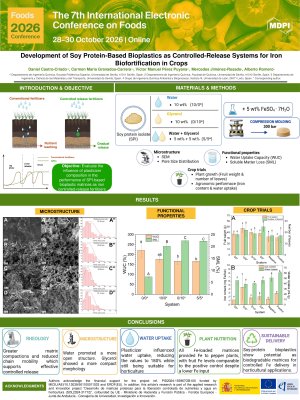
Introduction. Improving nutrient-use efficiency (NUE) is essential for sustainable food production. Controlled-release fertilizers (CRFs) allow gradual nutrient delivery synchronized with plant requirements. Biodegradable matrices from renewable resources are promising carriers. Soy protein isolate (SPI), an abundant by-product of the soybean oil industry, can be valorized to develop bioplastics for agricultural applications. This study evaluates SPI-based matrices as controlled iron-delivery systems and for crop biofortification in horticulture.
Materials and Methods. SPI was plasticized with water, glycerol or mixtures (5–15wt%), and iron sulphate heptahydrate (5wt%) as micronutrient. Tablets were produced by compression molding (300 bar). Materials were characterized by FTIR, thermogravimetric and dynamic mechanical analyses, water uptake and SEM microscopy. Selected formulations were evaluated in pepper plants to assess plant growth and iron bioavailability.
Results and Discussion. Water-plasticized systems exhibited higher stiffness and lower swelling, whereas glycerol increased flexibility and water absorption but with greater soluble matter loss. Release profiles were biphasic, showing a rapid initial stage followed by sustained delivery. Crop assays demonstrated improved plant growth and leaf coloration compared with unfertilized controls. Several formulations promoted higher iron accumulation in plant tissues, highlighting their potential as sustainable tools for crop iron biofortification.
Conclusions. SPI-based bioplastics are promising biodegradable carriers for CRFs. Their application improves NUE, supports crop iron biofortification and valorizes agro-industrial by-products, contributing to more sustainable food production systems.
Funding sources: This research is part of the project with reference SOL2024-31712, cofounded by UE - Ministerio de Hacienda y Función Pública-Fondos Europeos-Junta de Andalucía-Consejería de Universidad, Investigación e Innovación. Authors acknowledge the financial support of Agencia Andaluza de Cooperación Internacional para el Desarrollo through the project “Fortalecimiento de las capacidades de investigación e innovación tecnológica de la UNAH para el desarrollo de cultivos biofortificados mediante el uso de matrices bioplásticas enriquecidas con micronutrientes como fertilizantes sostenibles (Honduras)” (expedient 2025UC005).
Keywords
Soy protein
Bioplastics
Controlled-Release
Biofortification.
Poster
Foods poster_Bioplastics_VMPP.pdf
Physicochemical properties of stored Ga and Fante Kenkey Aflata-mix from maize-sweet potato composite dough
Technological pretreatments applied to traditional canary seed (Phalaris canariensis L.) for the production of flour suitable for human consumption