Event submissions
Published
This submission belongs to the session A. AI, Technology & Engineering in Food of the event The 7th International Electronic Conference on Foods
Published date
26 Oct, 2026
Academic Editor
 Nazimah Hamid
Citation
Brisa Mac William, Ana de Figueiredo, Isabel Riccobene, Luciana Girard, Technological pretreatments applied to traditional canary seed (Phalaris canariensis L.) for the production of flour suitable for human consumption, in Proceedings of The 7th International Electronic Conference on Foods, 28 October–30 October 2026, MDPI: Basel, Switzerland
Share
Email
Facebook
Twitter
LinkedIn
Technological pretreatments applied to traditional canary seed (Phalaris canariensis L.) for the production of flour suitable for human consumption

Brisa Mac William 1
Ana de Figueiredo 1
Isabel Riccobene 1
Luciana Girard 1
1. Department of Chemical Engineering and Food Technology, TECSE, National University of the Center of the Province of Buenos Aires, B7400JWI, Argentina
Abstract
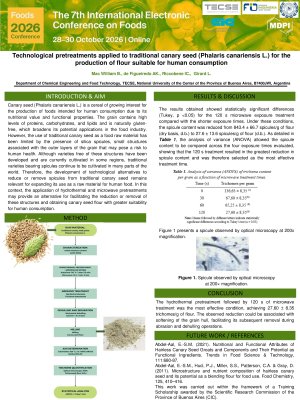
Traditional canary seed (Phalaris canariensis L.) has a high nutritional value and protein content, standing out for its tryptophan, cysteine, and phenylalanine content and for being gluten-free. These characteristics position it as a raw material with potential for the development of foods intended for human consumption. However, the varieties cultivated in Argentina have amorphous silica spicules in their hulls, which are potentially carcinogenic, limiting their use in food and requiring technological treatments to reduce or eliminate them. In this context, the objective of the present work was to evaluate the application of hydrothermal and microwave pretreatments to traditional canary seed grains to minimize spicules in the resulting flour. The studies were conducted by combining hydrothermal pretreatment (110°C, 1 atm, 15 min) followed by microwave exposure at three times (30 s, 60 s, and 120 s). The pretreated samples were then subjected to an abrasive treatment (1h, 175 rpm) in a specially designed equipment and a subsequent dehulling stage (pilot impact dehuller: 2960 rpm, 40 s). Finally, the samples were ground in a blade mill to obtain the flours. Spicules quantification was carried out using a microscope (Ernsleitz Wetzlar, Germany, 200X magnification) in previously calcined samples (550°C, 4 h) to avoid interference. The results obtained showed significant differences (Tukey, p < 0.05) at 120 s of microwave exposure compared to shorter times. Under these conditions, a reduction in spicules from 843.4 ± 66.7 spicules/g of flour (dry basis, d.b.) to 27.6 ± 13.6 spicules/g of flour (d.b.) was achieved. These results show that the combined application of hydrothermal and microwave pretreatments could reduce the presence of spicules in traditional canary seed flours, expanding their use in foods intended for human consumption.
Keywords
Traditional canary seed
Spicules
Hydrothermal pretreatment
Microwave
Poster
Sciforum-197872 Luciana Girard.pdf
Development of Soy Protein-Based Bioplastics as Controlled-Release Systems for Iron Biofortification in Crops
From Food Ethics to Food Citizenship – Reframing Food Security for Sustainable Food Systems in Central and Eastern Europe