Event submissions
Published
This submission belongs to the session E. Sustainable Food System & Food Security of the event The 7th International Electronic Conference on Foods
Published date
26 Oct, 2026
Academic Editor
 Siva S. Panda
Citation
Camila C. Muñoz-Realpe, María del Mar Contreras, Alfonso M. Vidal, Eulogio Castro, Inmaculada Romero, Phenolic compounds, xylose, and glucose production from vine shoots through sequential microwave-assisted processing, in Proceedings of The 7th International Electronic Conference on Foods, 28 October–30 October 2026, MDPI: Basel, Switzerland
Share
Email
Facebook
Twitter
LinkedIn
Phenolic compounds, xylose, and glucose production from vine shoots through sequential microwave-assisted processing

Camila C. Muñoz-Realpe 1

María del Mar Contreras 1
Alfonso M. Vidal 1
Eulogio Castro 1
Inmaculada Romero 1
1. Department of Chemical, Environmental and Materials Engineering, and Institute of Biorefineries Research (I3B). University of Jaén, Jaén, Spain
Abstract
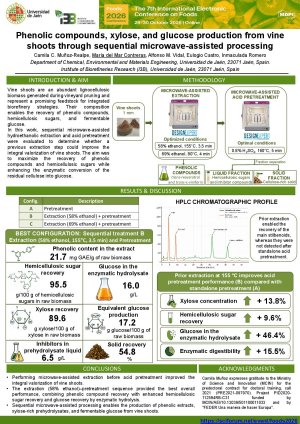
Vine shoots (VS) are an abundant lignocellulosic biomass whose valorization is crucial for advancing the circular bioeconomy in the grape and winery sectors. This study evaluated the effects of three process configurations for VS valorization using microwaves for extraction and pretreatment to obtain phenolic compounds and fermentable sugars. The three process configurations were: an acid pretreatment with 0.8% H2SO4 at 160°C for 5 min, and two sequential processes consisting of an extraction with 69% ethanol at 80°C for 4 min followed by acid pretreatment, and an extraction with 58% ethanol at 155°C for 3.5 min followed by the same pretreatment. The phenolic profiles of the extracts and pretreatment liquors were acquired by high-performance liquid chromatography (HPLC) at 280 nm. Moreover, the hemicellulosic sugars were also determined in the pretreatment liquors. Additionally, the pretreated solids were compositionally characterized and subjected to enzymatic hydrolysis for 72 h to obtain glucose.
The standalone pretreatment degraded VS stilbenoids, suggesting that the extraction should be performed as the primary operation in the valorization cascade. The sequential process involving extraction at 155 °C with 58% ethanol, followed by acid pretreatment, enabled obtaining an extract with a total phenolic content of 21.7 mg gallic acid equivalents/g VS (including the stilbenoids trans-resveratrol and trans-ε-viniferin) and showed the highest recovery of hemicellulosic sugars in the liquid fraction, i.e., 95.5 g/100 g of hemicellulosic sugars in raw biomass, mainly xylose. This previous extraction also facilitated subsequent enzymatic hydrolysis, yielding 16.0 g/L of glucose after 72 h (17.2 g of glucose/100 g VS), indicating that enzymatic digestibility increased from 41.2% to 56.7%.
In conclusion, integrating microwave-assisted extraction before pretreatment offers a more efficient route for VS valorization than standalone pretreatment.
Keywords
Antioxidants
extraction
pretreatment
resveratrol
fermentable carbohydrates
vine shoots
Poster
Poster_Foods2026.pdf
Powdered ingredients from olive pomace: Impact of drying temperature and defatting on bioactive potential
Valorization of Tannat grape seed residues after ultrasound assisted extraction of antioxidant compounds