Event submissions
Published
This submission belongs to the session E. Sustainable Food System & Food Security of the event The 7th International Electronic Conference on Foods
Published date
26 Oct, 2026
Academic Editor
 Siva S. Panda
Citation
Analía Martínez, Carla Bonifacino, Cecilia Dauber, Ignacio Vieitez, Cecilia Abirached, Valorization of Tannat grape seed residues after ultrasound assisted extraction of antioxidant compounds, in Proceedings of The 7th International Electronic Conference on Foods, 28 October–30 October 2026, MDPI: Basel, Switzerland
Share
Email
Facebook
Twitter
LinkedIn
Valorization of Tannat grape seed residues after ultrasound assisted extraction of antioxidant compounds

Analía Martínez 1,2

Carla Bonifacino 2
Cecilia Dauber 2

Ignacio Vieitez 2

Cecilia Abirached 2
1. Latitud – LATU Foundation, Ave. Italia 6201, Montevideo, 11500, Uruguay
2. Food Chemistry Area, Department of Food Science and Technology, Chemistry School, Universidad de la República, Ave. Gral. Flores 2124, Montevideo, 11800, Uruguay
Abstract
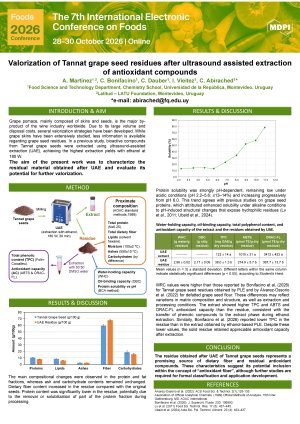
Grape pomace, mainly composed of skins and seeds, is the major by-product of the wine industry worldwide. Due to its large volume and disposal costs, several valorization strategies have been developed. While grape skins have been extensively studied, less information is available regarding grape seed residues. In a previous study, bioactive compounds from Tannat grape seeds were extracted using ultrasound-assisted extraction (UAE), achieving the highest extraction yields with ethanol at 180 W. The aim of the present work was to characterize the residual material obtained after UAE and evaluate its potential for further valorization. The residue generated after UAE using ethanol was analyzed for its proximate composition, water-holding capacity (WHC), oil-binding capacity (OBC), protein solubility as a function of pH, total phenolic content (TPC), and antioxidant capacity by ABTS and ORAC assays. The residue contained 67.8 ± 1.1% dietary fiber, 8.08 ± 0.23% protein, and 5.98 ± 0.16% lipids. WHC and OBC values were 2.96 ± 0.02 and 2.17 ± 0.09 g/g dry sample, respectively. Protein solubility increased progressively with pH and did not exhibit the typical U-shaped profile. TPC reached 38.0 ± 1.3 mg GAE/g dry residue, while antioxidant capacities were 274.9 ± 5.7 μmol TE/g and 387.7 ± 13.7 μmol TE/g dry residue for ABTS and ORAC, respectively. Although the residue showed limited techno-functional properties, it retained considerable levels of phenolic compounds and antioxidant activity. The residue obtained after UAE of Tannat grape seeds represents a promising source of dietary fiber and residual antioxidant compounds. These characteristics suggest its potential inclusion within the concept of “antioxidant fiber”, although further studies are required for formal classification and application development.
Keywords
Tannat grape seeds
ultrasound extraction
valorization
Poster
Sciforum-197610 Cecilia Abirached.pdf
Phenolic compounds, xylose, and glucose production from vine shoots through sequential microwave-assisted processing
Life Cycle Sustainability Assessment of Gluten-Free Food Systems: Evidence Gaps & Integration of Nutritional Functional Units