Event submissions
Published
This submission belongs to the session E. Sustainable Food System & Food Security of the event The 7th International Electronic Conference on Foods
Published date
26 Oct, 2026
Academic Editor
 Siva S. Panda
Citation
ADRIANA SKENDI, Stylianos Kalaitzidis, Elisavet Bouloumpasi, Thermal Stabilization and Kinetic Modeling of an Enriched Hydrophilic Extract from Grape Pomace Using Alginate-Carboxymethyl Cellulose Blended Hydrogels, in Proceedings of The 7th International Electronic Conference on Foods, 28 October–30 October 2026, MDPI: Basel, Switzerland
Share
Email
Facebook
Twitter
LinkedIn
Thermal Stabilization and Kinetic Modeling of an Enriched Hydrophilic Extract from Grape Pomace Using Alginate-Carboxymethyl Cellulose Blended Hydrogels

ADRIANA SKENDI 1
Stylianos Kalaitzidis 1
Elisavet Bouloumpasi 1
1. Department of Viticulture and Oenology, School of Agricultural and Forestry Sciences, Democritus University of Thrace, Drama, GR-66100, Greece.
Abstract
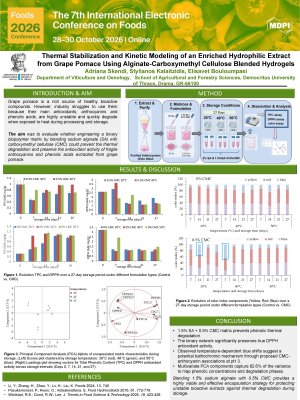
Introduction: This study investigated binary biopolymer matrix engineering to preserve fragile anthocyanins and phenolic acids in encapsulated aqueous grape pomace extracts under thermal stress.
Methods: An enriched hydrophilic aqueous phase stripped of lipophilic interferences was encapsulated in 2% pure sodium alginate (SA) or a 1.5% SA and 0.5% carboxymethyl cellulose (CMC) blend. Beads were stored for 27 days at 30°C, 40°C, and 50°C. Total Phenolic Content (TPC) and DPPH activity were monitored following complete matrix dissolution. Data were modelled using Three-Way Mixed ANOVA and Principal Component Analysis (PCA).
Results: A highly significant three-way interaction (P<0.001) confirmed undulating, non-monotonic profiles for both parameters, invalidating linear degradation models. For DPPH, the formulation effect was exceptionally robust (F(1, 6) = 1668.07, P<0.001); pure SA suffered an abrupt loss of radical scavenging activity by Day 7, whereas the CMC blend significantly stabilized and enhanced radical scavenging activity, uniquely peaking at 40°C on Day 7, hypothetically due to the matrix-promoted formation of acid-stable pyranoanthocyanins and highly structured intermolecular copigmentation complexes. Conversely, TPC showed a non-significant overall formulation effect (p=0.360). Heat degrades complex compounds in pure SA. This artificially raised the TPC scores even though the actual antioxidant power had crashed. In contrast, the CMC blend protected the extract and maintained close links between phenolic levels and antioxidant activity. PCA components of eigenvalues greater than 1.0 captured 82.6% of the variance. Variable contribution analysis confirmed PC1 mapped overall phenolic concentration, while PC2 and PC3 tracked proposed functional degradation and transient molecular association phases, respectively.
Conclusions: Standard linear modeling fails to capture the complex, multi-phasic kinetics of encapsulated grape pigments. Blending 0.5% CMC creates a dynamic molecular shield that prevents unchecked thermal cleavage, potentially redirecting degradation pathways toward highly stable, functional anthocyanin networks under thermal stress.
Keywords
Microencapsulation
enriched aqueous extract
Non-linear kinetics
Sodium alginate
Carboxymethyl cellulose
Three-Way ANOVA
PCA
Poster
Foods poster template-6aa0dcbaf0d8d ΑΣ 2026-10-13.pdf
Life Cycle Sustainability Assessment of Gluten-Free Food Systems: Evidence Gaps & Integration of Nutritional Functional Units
Climate-resilient native resources for sustainable bioeconomies: extraction and stabilization of bioactive compounds from Schinus molle, Neltuma ruscifolia and propolis