Event submissions
Published
This submission belongs to the session E. Sustainable Food System & Food Security of the event The 7th International Electronic Conference on Foods
Published date
26 Oct, 2026
Academic Editor
 Siva S. Panda
Citation
GIULIANA SILVINA SELING, Roy Cristian Rivero, Verónica María Busch, Pilar Buera, Climate-resilient native resources for sustainable bioeconomies: extraction and stabilization of bioactive compounds from Schinus molle, Neltuma ruscifolia and propolis, in Proceedings of The 7th International Electronic Conference on Foods, 28 October–30 October 2026, MDPI: Basel, Switzerland
Share
Email
Facebook
Twitter
LinkedIn
Climate-resilient native resources for sustainable bioeconomies: extraction and stabilization of bioactive compounds from Schinus molle, Neltuma ruscifolia and propolis

GIULIANA SILVINA SELING 1
Roy Cristian Rivero 2

Verónica María Busch 2
Pilar Buera 1
1. Department of Industrial Sciences, Faculty of Exact and Natural Sciences, University of Buenos Aires, Institute of Food Technology and Chemical Processes (ITAPROQ), CONICET, Buenos Aires C1428EGA, Argentina.
2. Faculty of Bromatology, National University of Entre Ríos, Institute of Food Science and Technology of Entre Ríos (ICTAER), National Scientific and Technical Research Council (CONICET), Gualeguaychú, Entre Ríos 2820, Argentina.
Abstract
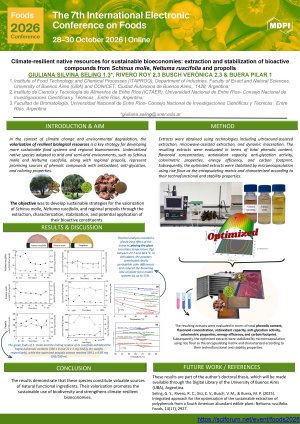
In the context of climate change and environmental degradation, the valorization of resilient biological resources is a key strategy for developing more sustainable food systems and regional bioeconomies. Underutilized native species adapted to arid and semi-arid environments, such as Schinus molle and Neltuma ruscifolia, along with regional propolis, represent promising sources of phenolic compounds with antioxidant, anti-glycation, and coloring properties. The objective was to develop sustainable strategies for the valorization of Schinus molle, Neltuma ruscifolia, and regional propolis through the extraction, characterization, stabilization, and potential application of their bioactive constituents. Extracts were obtained using technologies including ultrasound-assisted extraction, microwave-assisted extraction, and dynamic maceration. The resulting extracts were evaluated in terms of total phenolic content, flavonoid concentration, antioxidant capacity, anti-glycation activity, colorimetric properties, energy efficiency, and carbon footprint. Subsequently, the optimized extracts were stabilized by microencapsulation using rice flour as the encapsulating matrix and characterized according to their technofunctional and stability properties. The green fruits of S. molle and the milling residue of N. ruscifolia exhibited the highest phenolic contents (360 ± 8 and 72 ± 3 mg GAE/g dry weight, respectively), while the optimized propolis extract reached 339.1 ± 9.95 mg GAE/100 mL. The sustainability of the processes was validated using indicators such as a microwave energy consumption of 0.14 Wh/mg GAE for S. molle and a carbon footprint of 0.00025 kg CO₂/mg GAE for N. ruscifolia under ultrasound. The extracts showed antioxidant and anti-glycation potential, achieving polyphenol retentions of 61% for propolis, 37% for S. molle, and 25% for N. ruscifolia after microencapsulation. Thermal analysis revealed a plasticizing effect of the extracts, placing the glass transition temperature (Tg) between 27.7 and 30.9 °C. In extrudates, the powders contributed clearly perceptible color differences and reduced the browning rate constant (k) in model systems by up to 55%. The results demonstrate that these species constitute valuable sources of natural functional ingredients. Their valorization promotes the sustainable use of biodiversity and strengthens climate-resilient bioeconomies.
Keywords
Phenolic Compounds
Sustainable Extraction
Microencapsulation
Poster
P2-2.pdf
Thermal Stabilization and Kinetic Modeling of an Enriched Hydrophilic Extract from Grape Pomace Using Alginate-Carboxymethyl Cellulose Blended Hydrogels
Sustainable Recovery of Astaxanthin from Crustacean By-Products Using Green Extraction Technologies