Event submissions
Published
This submission belongs to the session E. Sustainable Food System & Food Security of the event The 7th International Electronic Conference on Foods
Published date
26 Oct, 2026
Academic Editor
 Siva S. Panda
Citation
Joana García de Mendoza, Mercè Granados, Sònia Sentellas, Javier Saurina, Oscar Nuñez, Sustainable Recovery of Astaxanthin from Crustacean By-Products Using Green Extraction Technologies, in Proceedings of The 7th International Electronic Conference on Foods, 28 October–30 October 2026, MDPI: Basel, Switzerland
Share
Email
Facebook
Twitter
LinkedIn
Sustainable Recovery of Astaxanthin from Crustacean By-Products Using Green Extraction Technologies

Joana García de Mendoza 1
Mercè Granados 1,2

Sònia Sentellas 1,2,3

Javier Saurina 1,2

Oscar Nuñez 1,2,3
1. Department of Chemical Engineering and Analytical Chemistry, Universitat de Barcelona, Barcelona, 08028, Spain
2. Research Institute in Food Nutrition and Food Safety, Universitat de Barcelona, Santa Coloma de Gramenet, 08921, Spain
3. Serra Húnter Fellow Programme, Generalitat de Catalunya, Barcelona, 08003, Spain
Abstract
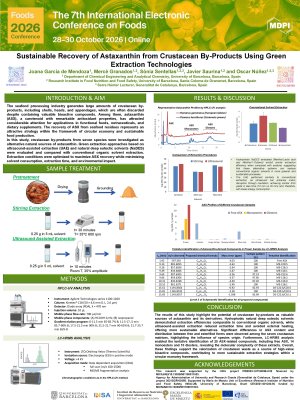
The seafood processing industry generates large amounts of crustacean by-products, including shells, heads, and appendages, which are often discarded despite containing valuable bioactive compounds. Among them, astaxanthin (ASX), a carotenoid with remarkable antioxidant properties, has attracted considerable attention for applications in functional foods, nutraceuticals, and dietary supplements. The recovery of ASX from seafood residues represents an attractive strategy within the framework of circular economy and sustainable food production.
In this study, crustacean by-products from seven species were investigated as alternative natural sources of astaxanthin. Green extraction approaches based on ultrasound-assisted extraction (UAE) and natural deep eutectic solvents (NaDES) were evaluated and compared with conventional organic solvent extraction. Extraction conditions were optimized to maximize ASX recovery while minimizing solvent consumption, extraction time, and environmental impact.
Among conventional solvents, acetone provided the highest extraction efficiency, being 1.7-fold higher in comparison to other solvents such as acetonitrile. UAE significantly reduced extraction time from 30 to 10 min while maintaining comparable yields. Furthermore, hydrophobic NaDES formulations based on naturally derived components showed promising extraction performance, demonstrating their potential as environmentally friendly alternatives to traditional organic solvents (exhibiting similar yields than with acetoner, 50 mg total ASX/kg dry sample).
Chromatographic analysis revealed substantial differences in astaxanthin content among the studied species, with Penaeus kerathurus showing the highest levels (55.5 mg total ASX/kg dry sample). Besides free astaxanthin, a complex profile of esterified forms was observed, highlighting the richness of these marine by-products as sources of high-value carotenoids.
Overall, the results demonstrate that crustacean processing residues can be efficiently transformed into valuable sources of natural astaxanthin through sustainable extraction technologies. The combination of UAE and NaDES constitutes a promising approach for the development of greener recovery processes, contributing to waste valorization, resource efficiency improved, and the implementation of circular economy principles in the seafood sector.
Keywords
Crustacean by-products
Astaxanthin
Green Extraction Techniques
Circular economy
Poster
Poster Foods2026_Green extraction ASX.pdf
Climate-resilient native resources for sustainable bioeconomies: extraction and stabilization of bioactive compounds from Schinus molle, Neltuma ruscifolia and propolis