Event submissions
Published
This submission belongs to the session S1. Generative AI: Paradigm Shifts in Finance and Economics of the event The 2nd International Online Conference on Risk and Financial Management
Published date
28 Oct, 2026
Academic Editor
 Svetlozar Zari Rachev
Contribution&Funding
Conceptualization,
[Aimad Sassioui] ; [Issam Benhayoun]
Methodology,
[Aimad Sassioui]
Software,
[Aimad Sassioui]
Validation,
[Aimad Sassioui] ; [Issam Benhayoun]
Formal analysis,
[Aimad Sassioui]
Investigation,
[Aimad Sassioui]
Data curation,
[Aimad Sassioui]
Writing - original draft,
[Aimad Sassioui]
Writing - review,
[editing] ; [Issam Benhayoun]
Visualization,
[Aimad Sassioui]
Supervision,
[Issam Benhayoun]
Project administration,
[Issam Benhayoun]
Funding: --
Citation
Aimad Sassioui, Issam Benhayoun, Artificial Intelligence and Audit Quality: A Systematic Review of Human–AI Interaction in Auditing., in Proceedings of The 2nd International Online Conference on Risk and Financial Management, 2 November–4 November 2026, MDPI: Basel, Switzerland
Share
Email
Facebook
Twitter
LinkedIn
Artificial Intelligence and Audit Quality: A Systematic Review of Human–AI Interaction in Auditing.

Aimad Sassioui 1
Issam Benhayoun 1
1. National School of Business and Management - ENCG, Moulay Ismail University, Meknès, 50001, Morocco
Abstract
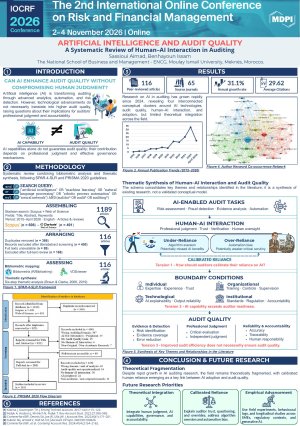
Artificial intelligence is increasingly transforming auditing by enhancing data processing, risk assessment, and decision support capabilities. Despite its growing adoption, the implications of AI for audit quality remain fragmented across diverse theoretical and empirical traditions. This study systematically reviews the literature on human–AI interaction in auditing to examine how audit quality is conceptualized, measured, and influenced in AI-enabled audit environments. Following the SPAR-4-SLR protocol, 116 peer-reviewed articles published between 2015 and April 2026 were identified from Scopus and Web of Science and screened through a PRISMA-compliant procedure. A mixed-method review design combining bibliometric analysis and deductive thematic synthesis was employed to address five research sub-questions. The findings reveal a rapidly expanding field but characterized by limited theoretical consolidation. Three distinct conceptions of audit quality emerge from the literature, namely performance-based, relational, and governance-based. However, these perspectives remain largely disconnected and offer no unified explanation of how AI influences audit outcomes. Across studies, reliance calibration emerges as the central mechanism shaping the relationship between auditors and AI systems. The review highlights how algorithm aversion, automation bias, and explainability influence auditors’ reliance decisions, while individual, technological, organizational, and institutional factors condition these effects. The analysis further reveals that fewer than half of the reviewed studies employ an explicit theoretical framework, and no single perspective adequately captures cognitive, organizational, and institutional dimensions simultaneously. The emergence of generative and agentic AI introduces additional challenges, including hallucinated outputs, narrative-driven automation bias, and reduced verifiability of audit evidence. This review reframes the debate from whether AI improves audit quality to how auditors establish appropriate reliance on AI systems and proposes directions for future theory development, empirical research, and regulatory consideration.
Keywords
Artificial intelligence
Audit quality
Human-AI interaction
Auditing
Systematic literature review
Poster
Artificial Intelligence and Audit Quality A Systematic Review of Human–AI Interaction in Auditing..pdf
Financial AI Literacy: Developing and Testing a New Scale for AI-Assisted Financial Decision-Making