Event submissions
Published
This submission belongs to the session S1. Generative AI: Paradigm Shifts in Finance and Economics of the event The 2nd International Online Conference on Risk and Financial Management
Published date
28 Oct, 2026
Academic Editor
 Svetlozar Zari Rachev
Citation
Ziyang Shi, AI, ESG, and Corporate Carbon Performance: The Moderating Role of Financing Constraints, in Proceedings of The 2nd International Online Conference on Risk and Financial Management, 2 November–4 November 2026, MDPI: Basel, Switzerland
Share
Email
Facebook
Twitter
LinkedIn
AI, ESG, and Corporate Carbon Performance: The Moderating Role of Financing Constraints

Ziyang Shi 1
1. School of Statistics and Data Science, Lanzhou University of Finance and Economics, Lanzhou, 730020, China
Abstract
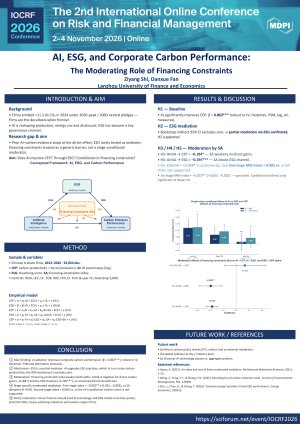
Amid the global pursuit of carbon neutrality, how artificial intelligence (AI) reshapes corporate environmental behavior and low-carbon transformation has attracted growing policy and academic interest. Using panel data of Chinese A-share listed firms covering 2012 to 2024, this paper adopts a moderated mediation model to systematically explore the impact of AI on corporate carbon emission performance (CEP), as well as the mediating role of ESG performance and the moderating effect of financing constraints. The empirical results show that AI significantly improves corporate carbon emission performance. ESG acts as a partial mediator: AI facilitates corporate carbon reduction by promoting firms’ comprehensive sustainable development. Financing constraints generate an asymmetric moderating effect along the mediation path. In the first stage, financing constraints weaken AI’s positive effect on ESG performance; in the second stage, they strengthen ESG’s contribution to lowering carbon emissions, forming a “restrain first, promote later” pattern. Heterogeneity tests demonstrate that this environmental effect of AI is more pronounced for state-owned enterprises, heavy-polluting firms and enterprises located in eastern China. Baseline outcomes remain valid after multiple robustness checks including core variable replacement and instrumental variable estimation. This study confirms that the environmental dividends brought by AI are highly conditional. It provides valuable implications for governments to design targeted green financial systems and support enterprises to formulate effective low-carbon transformation strategies.
Keywords
Artificial intelligence; Carbon emission performance; ESG performance; Financing constraints; Moderated mediation model
Poster
poster.pdf
Financial AI Literacy: Developing and Testing a New Scale for AI-Assisted Financial Decision-Making
Reconceptualizing Intellectual Capital through Generative AI: Evidence from Sustainable Banking Performance in Saudi Listed Banks