Event submissions
Published
This submission belongs to the session S1. Generative AI: Paradigm Shifts in Finance and Economics of the event The 2nd International Online Conference on Risk and Financial Management
Published date
28 Oct, 2026
Academic Editor
 Svetlozar Zari Rachev
Citation
Omar TAOUAB, Rajae Sabhi, ARTIFICIAL INTELLIGENCE AT THE HEART OF BEHAVIORAL FINANCE, in Proceedings of The 2nd International Online Conference on Risk and Financial Management, 2 November–4 November 2026, MDPI: Basel, Switzerland
Share
Email
Facebook
Twitter
LinkedIn
ARTIFICIAL INTELLIGENCE AT THE HEART OF BEHAVIORAL FINANCE

Omar TAOUAB 1
Rajae Sabhi 1
1. Laboratory of Research in Commerce and Management, Department of Economics and Management, National School of Business and Management (ENCG) Kenitra, Ibn Tofail University, Kenitra 14000, Morocco.
Abstract
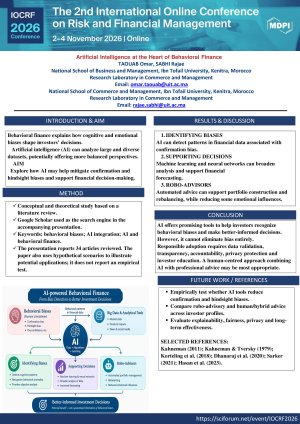
This paper explores the innovative role of artificial intelligence (AI) in mitigating behavioral biases in financial decision-making. Based on a theoretical framework grounded in behavioral finance, it examines how AI-powered tools can enhance rationality in investment choices. Behavioral biases, such as confirmation bias, hindsight bias, fixation bias, and overconfidence, are widely documented major factors that distort investor judgments and lead to suboptimal financial outcomes (Kahneman & Tversky, 1979; Barberis & Thaler, 2003).
This study employs a conceptual and exploratory approach, developing a theoretical model that demonstrates how AI systems, through machine learning algorithms, predictive analytics, and data-driven decision support, can help identify, mitigate, or even correct cognitive distortions in financial behavior. The paper presents several hypothetical scenarios to illustrate how AI can improve portfolio allocation, risk assessment, and market timing decisions by reducing emotional and cognitive interference.
This study examines in detail the advantages and disadvantages of integrating artificial intelligence (AI) into financial decision-making processes. While AI improves accuracy, efficiency, and objectivity, it also raises concerns regarding the transparency of algorithms, ethical considerations, and the reliability of models. The findings suggest that AI represents a promising, albeit complex, tool for enhancing the quality of decisions in the financial sector, opening new avenues for academic research and practical financial innovation.
Keywords
Bounded rationality
heuristics
confirmation bias
artificial intelligence
advisory robots.
Poster
Poster AI BF.pdf
Financial education and inclusion among middle school students in Romania
Revisiting AI in Finance and Economics: The Generative Paradigm and Its Implications for Markets and Policy