Event submissions
Published
This submission belongs to the session S1. Generative AI: Paradigm Shifts in Finance and Economics of the event The 2nd International Online Conference on Risk and Financial Management
Published date
28 Oct, 2026
Academic Editor
 Svetlozar Zari Rachev
Citation
İlknur Arslan Aras, Generative Artificial Intelligence in Financial Risk Management: A Structured Review of Applications, Risks, and Governance Challenges, in Proceedings of The 2nd International Online Conference on Risk and Financial Management, 2 November–4 November 2026, MDPI: Basel, Switzerland
Share
Email
Facebook
Twitter
LinkedIn
Generative Artificial Intelligence in Financial Risk Management: A Structured Review of Applications, Risks, and Governance Challenges

İlknur Arslan Aras 1
1. Department of Health Management, Faculty of Health Sciences, Yüksek İhtisas University, Ankara 06790, Türkiye.
Abstract
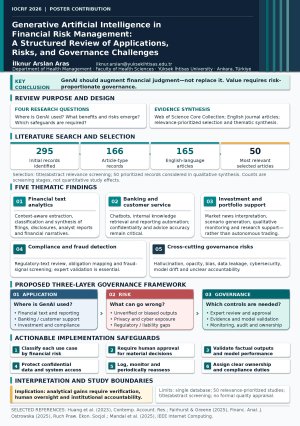
Ğenerative artificial intelligence and large language models are transforming financial risk management, banking, investment analysis, regulatory compliance, and fintech governance. This study aims to synthesize the emerging literature on the applications, risks, and governance challenges of generative AI in finance. A structured systematic literature review was conducted using the Web of Science Core Collection. The initial search identified 295 records. After filtering for article-type publications, 166 records remained; after restricting the language to English, 165 articles were retained. For conference submission, the 50 most relevant articles were screened through title and abstract review and analyzed thematically.
Preliminary findings indicate that the literature clusters around five themes: AI-enabled financial text analysis, banking and customer-service applications, investment and portfolio decision support, regulatory compliance and fraud detection, and governance-oriented concerns including explainability, privacy, bias, hallucination, accountability, cybersecurity, and model risk. The reviewed studies suggest that generative AI can improve information extraction from financial documents, automate reporting, support scenario generation, enhance fraud monitoring, and assist decision-making under uncertainty. However, its adoption also creates operational, ethical, reputational, and regulatory vulnerabilities, particularly when outputs are inaccurate, opaque, biased, or insufficiently supervised.
The study concludes that generative AI should not be implemented as an autonomous substitute for professional judgment in financial institutions. Instead, its integration requires human oversight, transparent validation processes, data-protection safeguards, explainable model design, institutional accountability mechanisms, and alignment with emerging regulatory expectations. These findings contribute to risk and financial management debates by framing generative AI as both a strategic innovation and a governance challenge.
Keywords
Generative artificial intelligence
large language models
financial risk management
fintech
governance
compliance
explainable AI
systematic review
Poster
IOCRF2026_Poster_No_AI_Disclosure.pdf
The determinants of AI Washing in Corporate Reporting: Strategic Antecedents and Path Dependence of Symbolic Technological Narratives.
Indian Consumers and AI-Generated Green Finance Messaging: Trust, Skepticism and Purchase Intention