Event submissions
Published
This submission belongs to the session S1. Generative AI: Paradigm Shifts in Finance and Economics of the event The 2nd International Online Conference on Risk and Financial Management
Published date
28 Oct, 2026
Academic Editor
 Svetlozar Zari Rachev
Citation
Gustav Olaf Yunus Laitinen-Fredriksson Lundstrom-Imanov, Rana Irem Turhan, Simulating Systemic Market Crashes and Behavioral Cascades Using Generative AI Multi-Agent Systems, in Proceedings of The 2nd International Online Conference on Risk and Financial Management, 2 November–4 November 2026, MDPI: Basel, Switzerland
Share
Email
Facebook
Twitter
LinkedIn
Simulating Systemic Market Crashes and Behavioral Cascades Using Generative AI Multi-Agent Systems

Gustav Olaf Yunus Laitinen-Fredriksson Lundstrom-Imanov 1
Rana Irem Turhan 2
1. School of Information and Communication Technology, Metropolia University of Applied Sciences, Espoo 02610, Finland
2. Department of Computer Systems, Riga Technical University, Riga LV-1048, Latvia
Abstract
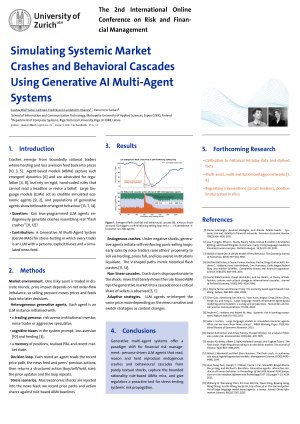
Introduction: Traditional agent-based models (ABMs) in finance rely on rigid, rule-based heuristics that fail to capture the complex, bounded rationality and psychological biases of human traders. This study introduces a novel framework utilizing Generative AI Multi-Agent Systems to simulate systemic market crashes and behavioral cascades in financial networks.
Methods: We construct a simulated financial market environment populated by multiple heterogeneous Large Language Model (LLM)-based agents. Each agent is initialized with unique trading personas (e.g., risk-averse institutional investor, noise trader, aggressive speculator) and programmed with cognitive biases, including herding behavior and loss aversion. The agents interact dynamically, executing trades based on real-time simulated financial news feeds and macroeconomic shocks.
Results: Our simulations demonstrate that LLM-based agents exhibit realistic emergent behaviors under stress. When subjected to negative macroeconomic shocks, generative agents initiate self-reinforcing panic-selling loops, generating endogenous market crashes that closely mimic historical "flash crashes." Unlike traditional ABMs, these generative agents dynamically adapt their strategies based on contextual textual information, leading to complex, non-linear behavioral cascades.
Conclusions: This research highlights the paradigm-shifting potential of generative multi-agent systems in financial risk management. By providing a more realistic simulation of market dynamics, our framework offers regulators and financial institutions a robust, proactive tool for stress-testing and predicting systemic risk propagation.
Keywords
Generative AI
Multi-Agent Systems
Systemic Risk
Financial Simulation
Behavioral Cascades
Market Crashes
Poster
Poster_ICRFM2026.pdf
FINLLAMA: PARAMETER-EFFICIENT FINANCIAL SENTIMENT LEARNING USING LARGE LANGUAGE MODELS
Revisiting Equity–Bond Diversification: Tail Risk, Extreme Events and Option–Implied Evidence from Global ETFs.