Event submissions
Published
This submission belongs to the session S2. Machine Learning for Next-Generation Risk Modeling of the event The 2nd International Online Conference on Risk and Financial Management
Published date
28 Oct, 2026
Academic Editor
 Thanasis Stengos
Contribution&Funding
Conceptualization,
[Sarah Njweng Chi]
Methodology,
[Sarah Njweng Chi]
Investigation,
[Sarah Njweng Chi]
Writing - original draft,
[Sarah Njweng Chi]
Writing - review,
[editing] ; [Sarah Njweng Chi]
Visualization,
[Sarah Njweng Chi]
Funding: --
Citation
Sarah Njweng Chi, An Explainable AI–Enabled Risk-Adjusted Financing Framework for Investment Readiness in Fragile Agri-Food Systems, in Proceedings of The 2nd International Online Conference on Risk and Financial Management, 2 November–4 November 2026, MDPI: Basel, Switzerland
Share
Email
Facebook
Twitter
LinkedIn
An Explainable AI–Enabled Risk-Adjusted Financing Framework for Investment Readiness in Fragile Agri-Food Systems

Sarah Njweng Chi 1
1. Risk and Compliance, UNWFP, Kampala, 00256, Uganda
Abstract
Agri-food enterprises operating in fragile settings—characterised by climate exposure, conflict, weak institutions, or acute market volatility—face interconnected financial, operational, and governance risks that constrain investment readiness and discourage capital providers. Conventional financing assessments often rely on static financial indicators, limited historical data, and standardised risk thresholds that may overestimate risk, overlook resilience, and inadequately reflect these enterprises' operating realities. This protocol paper outlines a proposed explainable artificial intelligence (XAI)-enabled risk-adjusted financing framework for assessing investment readiness and supporting transparent financing decisions in such contexts.
The framework will integrate enterprise-level financial and non-financial data—drawn from smallholder and SME agri-food enterprises in climate-vulnerable and institutionally weak regions—with contextual risk indicators to generate multidimensional risk profiles, investment-readiness scores, and differentiated financing recommendations. Supervised machine-learning models will estimate financing viability and risk, while SHapley Additive exPlanations (SHAP) will demonstrate how specific variables shape each assessment, addressing the tension between predictive performance and interpretability where opaque models risk reinforcing information asymmetries or excluding enterprises with incomplete records (Bussmann et al., 2020; Černevičienė and Kabašinskas, 2022).
A mixed-methods design combining enterprise and investment data, stakeholder interviews, and expert validation is proposed. Model performance will be assessed against predictive accuracy, calibration, robustness, and interpretability, alongside fairness criteria examining whether outputs disadvantage enterprises with sparse credit histories, such as women-led or smallholder ventures. Human oversight remains embedded throughout to contextualise outputs and prevent fully automated determinations.
This study contributes an integrated approach linking risk assessment, investment readiness, financing design, and explainable machine learning, intended to help investors distinguish perceived from empirically supported risk, and to improve capital allocation toward resilient ventures in fragile settings.
Keywords
explainable artificial intelligence; risk-adjusted financing; investment readiness; fragile agri-food systems; machine learning; blended finance
Poster
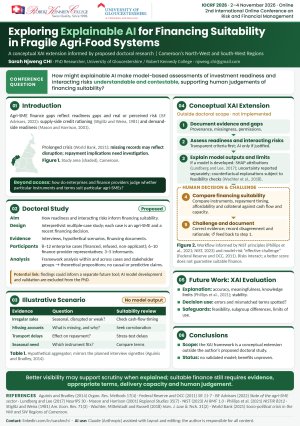
IOCRF2026_XAI_Poster_CHI_v9_38x54cm.pdf
Generative and Stochastic Modeling for Financial Risk Management: Hybrid Approaches for Forecasting and Fraud Detection
Do Macroeconomic Conditions and GDELT Financial News Sentiment Improve NIFTY 50 Forecasts? A Point-in-Time Out-of-Sample Evaluation