Event submissions
Published
This submission belongs to the session S2. Machine Learning for Next-Generation Risk Modeling of the event The 2nd International Online Conference on Risk and Financial Management
Published date
28 Oct, 2026
Academic Editor
 Thanasis Stengos
Contribution&Funding
Conceptualization,
[Tzuling Hsieh]
Methodology,
[Tzuling Hsieh]
Software,
[Tzuling Hsieh]
Validation,
[Tzuling Hsieh]
Formal analysis,
[Tzuling Hsieh]
Investigation,
[Tzuling Hsieh]
Data curation,
[Tzuling Hsieh]
Writing - original draft,
[Tzuling Hsieh]
Writing - review,
[editing] ; [Dragos Bozdog]
Visualization,
[Tzuling Hsieh]
Supervision,
[Dragos Bozdog]
Project administration,
[Dragos Bozdog]
Funding: --
Citation
Tzuling Hsieh, Dragos Bozdog, Friction, Not Magnitude: Illiquidity-Driven Mean Reversion in Crude Oil Futures, in Proceedings of The 2nd International Online Conference on Risk and Financial Management, 2 November–4 November 2026, MDPI: Basel, Switzerland
Share
Email
Facebook
Twitter
LinkedIn
Friction, Not Magnitude: Illiquidity-Driven Mean Reversion in Crude Oil Futures

Tzuling Hsieh 1
Dragos Bozdog 2
1. Financial Engineering, Stevens Institute of Technology, Hoboken, New Jersey, USA
2. School of business, Stevens Institute of Technology, Hoboken, New Jersey, USA
Abstract
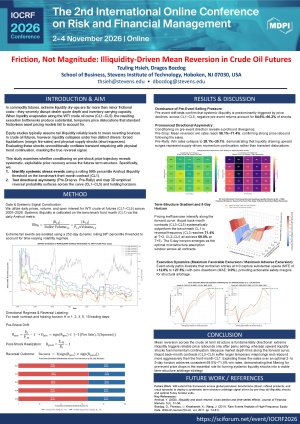
Abstract: This study examines how market microstructure dynamics and liquidity constraints drive price anomalies across the crude oil futures term structure, specifically analyzing contracts from the near month (CL1) to the far month (CL5). By utilizing the Amihud illiquidity measure, the research systematically contrasts anomalous price behavior under extreme illiquidity regimes against periods of high market liquidity. The analysis employs daily data spanning from January 2001 to June 2006 to ensure a comprehensive evaluation across different market conditions.
The empirical findings demonstrate that extreme illiquidity shocks trigger a pronounced and statistically significant mean-reversion effect. Specifically, applying a contrarian long-only entry upon daily price declines on far-month contracts (CL5) following illiquidity-driven drops yields a 70.0% win rate and an average maximum favorable excursion (MFE) of 11.48% over a 20-day holding period. Conversely, when equivalent price declines occur within high-liquidity environments, they generate persistent downward momentum rather than a corrective reversion. Under these high-liquidity conditions, the Maximum Adverse Excursion (MAE) significantly exceeds the Maximum Favorable Excursion (MFE), resulting in a negative expected return for contrarian strategies.
Furthermore, the study identifies a distinct term structure effect regarding market efficiency: illiquid far-month contracts (CL5) retain pricing inefficiencies for substantially longer durations compared to the highly liquid and heavily traded near-month contracts (CL1). Overall, these results demonstrate that term-structure mean reversion depends conditionally on the prevailing liquidity regime rather than the absolute magnitude of the price shock alone. By isolating the impact of liquidity friction, this research establishes a rigorous quantitative foundation for developing structural arbitrage strategies in commodity futures markets.
Keywords
market microstructure
liquidity friction
crude oil futures
term structure
Amihud illiquidity measure
mean reversion
momentum
Poster
Friction, Not Magnitude Illiquidity Driven Mean Reversion in Crude Oil Futures, Tzuling Hsieh, Dragos Bozdog.pdf
Regime Effects Are Turnover Effects: Matched Controls for Conditional Portfolio Optimization
Machine Learning in Market Risk and Model Risk Governance: A Framework for Regulatory-Compliant Adoption in Investment Fund Contexts