Event submissions
Published
This submission belongs to the session S2. Machine Learning for Next-Generation Risk Modeling of the event The 2nd International Online Conference on Risk and Financial Management
Published date
28 Oct, 2026
Academic Editor
 Thanasis Stengos
Citation
Andreea Chiruta (Negru), Machine Learning in Market Risk and Model Risk Governance: A Framework for Regulatory-Compliant Adoption in Investment Fund Contexts, in Proceedings of The 2nd International Online Conference on Risk and Financial Management, 2 November–4 November 2026, MDPI: Basel, Switzerland
Share
Email
Facebook
Twitter
LinkedIn
Machine Learning in Market Risk and Model Risk Governance: A Framework for Regulatory-Compliant Adoption in Investment Fund Contexts

Andreea Chiruta (Negru) 1
1. Risk Management, Impetum Investments, Bucharest, 020656, Romania
Abstract
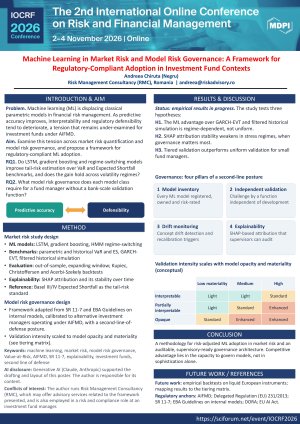
The progressive displacement of classical parametric models by machine learning architectures in financial risk management presents a structural tension that remains undertheorized in the literature: as predictive accuracy improves, model interpretability and regulatory defensibility frequently deteriorate. This paper examines that tension across two interconnected domains, market risk quantification and model risk governance, with particular attention to investment fund environments operating under AIFMD and equivalent frameworks.
On the market risk side, the paper evaluates the performance of ML-native approaches, including long short-term memory networks, gradient boosting ensembles, and hidden Markov regime-switching models, against traditional Value-at-Risk and Expected Shortfall methodologies under Basel III/IV constraints. It argues that ML models offer material advantages in tail risk estimation and volatility regime detection, but introduce non-trivial validation challenges that incumbent frameworks were not designed to address.
On the governance side, the paper develops a model risk management framework adapted from SR 11-7 and EBA Guidelines on Internal Models, calibrated to the operational realities of alternative investment managers. The framework addresses model inventory, independent validation, concept drift monitoring, and explainability requirements as constituent pillars of a second-line-of-defense posture.
The contribution is twofold: a structured methodology for risk-adjusted ML model adoption in market risk, and a governance architecture that renders that adoption auditable and supervisory-ready. The paper concludes that competitive advantage in next-generation risk management lies not in model sophistication per se, but in the institutional capacity to govern sophisticated models rigorously.
Keywords
machine learning
market risk
model risk governance
Value-at-Risk
AIFMD
SR 11-7
explainability
investment funds
second line of defense
Poster
IOCRF2026_poster_Andreea Chiruta.pdf
Friction, Not Magnitude: Illiquidity-Driven Mean Reversion in Crude Oil Futures
Explainable Machine Learning for Corporate Financial Distress Classification: Evidence from Albanian Enterprises Receiving the Largest State Treasury Payments