Event submissions
Published
This submission belongs to the session S2. Machine Learning for Next-Generation Risk Modeling of the event The 2nd International Online Conference on Risk and Financial Management
Published date
28 Oct, 2026
Academic Editor
 Thanasis Stengos
Contribution&Funding
Conceptualization,
[Ali Ait Sidi Lkhir]
Methodology,
[Ali Ait Sidi Lkhir]
Formal analysis,
[Ali Ait Sidi Lkhir]
Writing - original draft,
[Ali Ait Sidi Lkhir]
Funding: --
Citation
Ali Ait Sidi Lkhir, Aggregation Choice and the Limits of Machine Learning in Financial Stress Measurement: Evidence from Twenty Emerging Markets, 2007–2025, in Proceedings of The 2nd International Online Conference on Risk and Financial Management, 2 November–4 November 2026, MDPI: Basel, Switzerland
Share
Email
Facebook
Twitter
LinkedIn
Aggregation Choice and the Limits of Machine Learning in Financial Stress Measurement: Evidence from Twenty Emerging Markets, 2007–2025

Ali Ait Sidi Lkhir 1
1. Faculty of Economics and Management, Abdelmalek Essaadi University, Tangier, 90000, Morocco
Abstract
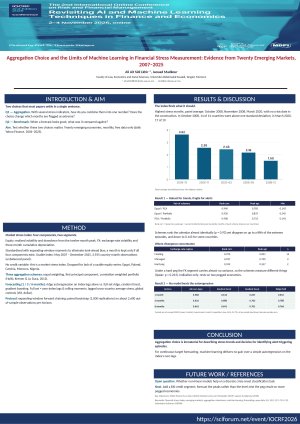
Introduction. Composite stress indices inform macroprudential surveillance, yet two questions remain under-examined: how sensitive their extreme readings are to the aggregation scheme, and whether machine learning improves stress forecasting against a well-specified autoregressive benchmark. Both are addressed for emerging markets using open data only.
Methods. A monthly market stress index is built for twenty emerging economies from daily Yahoo Finance series, 2004–2025. Four components enter: equity volatility, equity drawdown from the twelve-month peak, exchange-rate volatility, and three-month cumulative depreciation. Components are standardised with expanding-window moments to eliminate look-ahead bias; only months with all four components are retained. The usable index spans May 2007 to December 2025: 3,935 country-month observations, unbalanced panel. Three aggregation schemes are compared: equal weighting, first principal component, and a correlation-weighted portfolio scheme (Holló, Kremer and Lo Duca, 2012). Forecasts at one, three and six months compare a ridge autoregression on index lags alone with a full-set ridge, a random forest and a gradient-boosting model. The full feature set comprises own-index lags and rolling moments, lagged cross-country average stress, and global controls (VIX, dollar). Evaluation uses expanding-window forward chaining with paired bootstrap inference on roughly 2,600 out-of-sample observations per horizon.
Results. Peak stress months are October 2008 and March 2020, identified without crisis-date input. Rank correlation across schemes averages 0.908–0.940, yet agreement on top-decile episodes, measured by Jaccard similarity between peak sets, falls to 0.755–0.837 and to 0.143 for individual countries, with divergence concentrated in pegged-currency economies. No specification beats the autoregressive benchmark at any horizon: root mean squared error deteriorates by 4.6–24.7 per cent, all bootstrap intervals excluding zero.
Conclusions. Aggregation choice is immaterial for describing stress trends and decisive for identifying alert-triggering episodes. For continuous-target forecasting, machine learning delivers no gain; whether non-linear models help on discrete classification tasks such as crisis-onset prediction remains open.
Keywords
financial stress index; emerging markets; aggregation robustness; machine learning; forecasting; open data
Poster
IOCRF2026_AIT SIDI LKHIR ALi.pdf
Can Old and New Models Work Together? Predicting Volatility across U.S. Sectors with GARCH and Machine Learning
A Regime-Gated Hybrid Forecasting Framework: Coupling Autoregressive Distributed Lags, Smooth-Transition Dynamics, and Kolmogorov–Arnold Residual Learning